
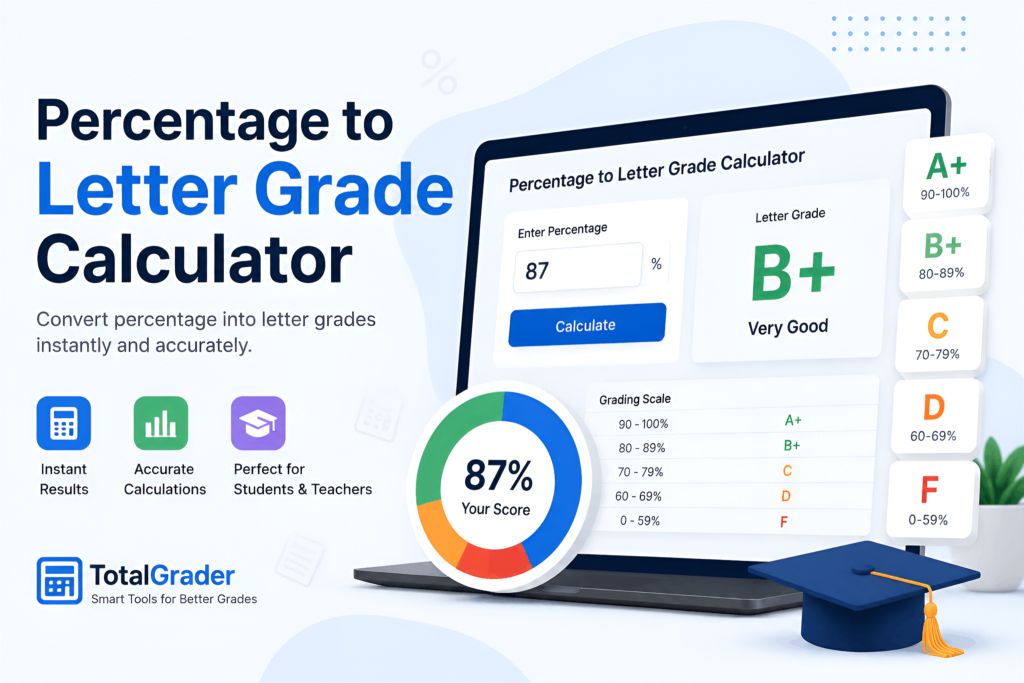
Percentage to Letter Grade Calculator
A Percentage to Letter Grade Calculator helps students quickly convert a numerical percentage into a letter grade such as A, B, C, D, or F. Instead of manually checking a grading chart, you can enter your percentage and immediately find the corresponding letter grade.
For example, under a common 10-point grading scale, a score of 95% is an A, 85% is a B, 75% is a C, 65% is a D, and a score below 60% is an F. However, grading systems are not universal. Some schools and colleges use plus/minus grades such as A-, B+, and C-, while others use different percentage boundaries.
Use the Percentage to Letter Grade Calculator above to convert your score quickly, then compare the result with your school’s official grading policy.
What Is a Percentage to Letter Grade Calculator?
A Percentage to Letter Grade Calculator is an online tool that converts a percentage score into its equivalent letter grade.
For example:
- 95% → A
- 87% → B
- 76% → C
- 65% → D
- 55% → F
The exact result depends on the grading scale selected by your school, teacher, college, or university.
A calculator is particularly useful after receiving an exam, assignment, quiz, or course score because it lets you understand your performance without searching through a grading chart manually.
Why Use a Percentage to Letter Grade Calculator?
Students commonly use a percentage-to-grade calculator to:
- Convert exam scores into letter grades
- Check assignment grades
- Understand final course percentages
- Estimate academic performance
- Compare scores with a grading scale
- Determine whether a score falls near a grade boundary
- Understand the difference between standard and plus/minus scales
- Quickly check grades before calculating GPA
The calculator is especially useful when you have a percentage but your school reports academic performance using letters.
Percentage to Letter Grade Chart
A common U.S. 10-point grading scale uses the following ranges:
| Percentage | Letter Grade | Common GPA Value |
|---|---|---|
| 90%–100% | A | 4.0 |
| 80%–89% | B | 3.0 |
| 70%–79% | C | 2.0 |
| 60%–69% | D | 1.0 |
| 0%–59% | F | 0.0 |
This is a commonly used scale, but it should not be treated as a universal grading standard. Individual institutions and instructors can establish different cutoffs.
For example, one school might consider 90% an A, while another might require 93% for an A. This is why you should check your syllabus or official grading policy when the exact letter grade matters.
How to Convert a Percentage to a Letter Grade
Converting a percentage to a letter grade is usually a simple comparison between your score and the grading scale.
Step 1: Find Your Percentage
Start with your final percentage.
For example:
85%
Step 2: Check the Grading Scale
Using the common 10-point scale:
- A = 90%–100%
- B = 80%–89%
- C = 70%–79%
- D = 60%–69%
- F = below 60%
Step 3: Match Your Score
Because 85% falls between 80% and 89%, the corresponding letter grade is:
85% = B
That’s all you need to do for a basic percentage-to-letter conversion.
Percentage to Letter Grade Examples
Here are several examples using a common 10-point grading scale.
100% to Letter Grade
100% = A
A score of 100% is at the top of the A range.
95% to Letter Grade
95% = A
Because 95% is between 90% and 100%, it receives an A on the common 10-point scale.
90% to Letter Grade
90% = A
Under a 90/80/70/60 scale, 90% is the minimum score required for an A.
89% to Letter Grade
89% = B
An 89% falls just below the 90% A boundary on the standard 10-point scale.
85% to Letter Grade
85% = B
An 85% falls within the 80%–89% B range.
80% to Letter Grade
80% = B
An 80% is generally the minimum percentage for a B under the common 10-point scale.
79% to Letter Grade
79% = C
A 79% falls below the 80% B boundary and therefore becomes a C under this scale.
75% to Letter Grade
75% = C
A 75% falls within the 70%–79% C range.
70% to Letter Grade
70% = C
On the standard 10-point scale, 70% is generally the minimum score for a C.
69% to Letter Grade
69% = D
A 69% falls within the 60%–69% D range.
60% to Letter Grade
60% = D
A score of 60% is generally the lower boundary of the D range on this scale.
59% to Letter Grade
59% = F
A score below 60% is an F under the common 10-point grading scale.
What Is the Plus/Minus Grading Scale?
Some schools and colleges divide each major letter grade into smaller categories.
Instead of simply having A, B, C, D, and F, a plus/minus scale can include:
- A+
- A
- A-
- B+
- B
- B-
- C+
- C
- C-
- D+
- D
- D-
- F
A commonly used U.S. plus/minus scale looks like this:
| Percentage | Letter Grade | Common GPA |
|---|---|---|
| 97%–100% | A+ | 4.0 |
| 93%–96% | A | 4.0 |
| 90%–92% | A- | 3.7 |
| 87%–89% | B+ | 3.3 |
| 83%–86% | B | 3.0 |
| 80%–82% | B- | 2.7 |
| 77%–79% | C+ | 2.3 |
| 73%–76% | C | 2.0 |
| 70%–72% | C- | 1.7 |
| 67%–69% | D+ | 1.3 |
| 63%–66% | D | 1.0 |
| 60%–62% | D- | 0.7 |
| Below 60% | F | 0.0 |
This is a common reference scale, but individual institutions can use different boundaries and GPA values.
For that reason, an 87% could be a B+ on one scale but simply a B on another scale.
Standard Scale vs. Plus/Minus Scale
The biggest difference between these systems is the number of grade categories.
With a basic grading scale:
85% = B
With a plus/minus scale:
85% = B
So the result may sometimes be identical.
However:
87% = B+ on a common plus/minus scale, while it remains B on a basic A–F scale.
Similarly:
79% = C+ on a common plus/minus scale, but C on a basic 10-point scale.
This shows why knowing the grading scale is important before interpreting a letter grade.

How Does the Calculator Determine Your Letter Grade?
A percentage-to-letter calculator normally works by comparing your score against predefined minimum thresholds.
For a basic scale, the logic can be represented as:
- If the percentage is 90 or higher → A
- If the percentage is 80 or higher → B
- If the percentage is 70 or higher → C
- If the percentage is 60 or higher → D
- If the percentage is below 60 → F
For example, if you enter 82%, the calculator checks the ranges from highest to lowest.
Because 82% is below 90% but at least 80%, the result is:
82% = B
For a plus/minus scale, there are more thresholds, so the calculator can provide a more specific result such as B-, B, or B+.
How to Calculate Your Percentage From Points
If you don’t already know your percentage, you can calculate it from the points you earned.
Use this formula:
Percentage = (Points Earned ÷ Total Points) × 100
Example
Suppose you earned:
42 points out of 50
First divide:
42 ÷ 50 = 0.84
Then multiply by 100:
0.84 × 100 = 84%
Using the common 10-point grading scale:
84% = B
So a student who earns 42 out of 50 receives an 84% percentage score, which corresponds to a B on that scale.
How to Convert a Score Out of 100 to a Letter Grade
If your test is already scored out of 100, the number itself is your percentage.
For example:
- 98/100 = 98% = A
- 92/100 = 92% = A
- 88/100 = 88% = B
- 81/100 = 81% = B
- 74/100 = 74% = C
- 66/100 = 66% = D
- 58/100 = 58% = F
No additional percentage calculation is required.
How to Convert a Score Out of 50 to a Letter Grade
When an assessment is not out of 100, calculate the percentage first.
For example, suppose you scored:
43 out of 50
Use:
(43 ÷ 50) × 100 = 86%
Therefore:
86% = B under the common basic 10-point scale.
If your school uses a plus/minus scale, 86% may also correspond to a B.
How to Convert a Score Out of 20 to a Letter Grade
Suppose your score is:
17 out of 20
Calculate:
(17 ÷ 20) × 100 = 85%
Therefore:
85% = B on the common 10-point scale.
The same process works for any maximum score.
For example:
18/20 = 90%
19/20 = 95%
16/20 = 80%
Can a Percentage Have a Decimal?
Yes. Your percentage can include decimals.
For example:
- 89.5%
- 92.5%
- 76.75%
- 84.25%
Decimal scores are particularly important when your grade is close to a cutoff.
For example, if the grading scale requires 90% for an A:
89.9% is still below 90%.
90.0% reaches the A threshold.
However, your school may have specific rounding rules. Some institutions may calculate grades using the exact decimal value, while others may round final grades. Always follow the grading policy that applies to your course.
What Grade Is 90 Percent?
On the common 10-point grading scale:
90% = A
However, on a plus/minus scale, 90% may be classified as A- rather than A.
This is an excellent example of why you should know which grading system your school uses.
What Grade Is 80 Percent?
On a basic 10-point scale:
80% = B
On a common plus/minus scale:
80% = B-
Therefore, the same numerical score can have a different letter grade depending on the grading system.
What Grade Is 70 Percent?
On the common 10-point scale:
70% = C
On a common plus/minus scale:
70% = C-
Again, the exact result depends on your institution’s grading policy.
What Grade Is 60 Percent?
On the common 10-point scale:
60% = D
On a common plus/minus scale:
60% = D-
A score below 60% is generally an F under these commonly referenced U.S. scales.
What Grade Is 75 Percent?
Using the basic 10-point scale:
75% = C
Using a common plus/minus scale:
75% = C
So in this case, both scales can produce the same major letter grade, although the exact boundaries differ within some ranges.
Does a Letter Grade Equal a GPA?
Not necessarily.
A letter grade can be associated with a GPA value, but the exact GPA conversion depends on the grading system used by your school.
For example, a common 4.0 scale may associate:
- A = 4.0
- B = 3.0
- C = 2.0
- D = 1.0
- F = 0.0
A plus/minus system may use more detailed values such as:
- A- = 3.7
- B+ = 3.3
- B- = 2.7
- C+ = 2.3
- C- = 1.7
- D+ = 1.3
- D- = 0.7
These values are commonly used but are not universal.
If you need your overall GPA rather than the grade for one score, you should use a GPA calculator that accounts for course credits and individual grades.
Percentage to Letter Grade vs. GPA Calculation
These two calculations are related but different.
Percentage to Letter Grade
This process answers:
“What letter grade does my percentage represent?”
For example:
85% → B
GPA Calculation
GPA calculation answers:
“What is my average grade-point value across my courses?”
For example, a student’s GPA may depend on:
- Letter grades
- Grade points
- Course credits
- Credit hours
- The institution’s GPA rules
Therefore, converting a percentage to a letter grade does not automatically determine your cumulative GPA.
Why Can Two Schools Give Different Letter Grades for the Same Percentage?
There is no single grading scale that every school, college, and university must use.
One institution may use:
90% = A
Another may use:
93% = A
Some institutions also use plus/minus grades, while others only use whole letter grades.
For example, an 89% could be:
- B on a basic 10-point scale
- B+ on a common plus/minus scale
- A- under a different institutional grading policy
Therefore, your instructor’s syllabus or official academic grading policy should always take priority over a general online conversion chart.
Does Every Country Use the Same Grading Scale?
No.
Grading systems vary between countries and educational institutions.
For example, percentage scores can be interpreted differently in the United States, United Kingdom, Australia, Europe, Pakistan, Canada, and other education systems.
Even within the same country, schools and universities can establish their own grading rules.
This means you should avoid assuming that a percentage automatically has one universal letter-grade equivalent.
If you are applying to another school or university, use the conversion rules requested by that institution rather than relying solely on a generic calculator.
Percentage to Letter Grade Calculator for Students
Students can use this calculator for many different academic situations, including:
Exams
Enter your exam percentage to quickly identify the corresponding letter grade.
Quizzes
A quiz score can be converted from a percentage into a letter grade without manually checking a chart.
Assignments
If your assignment is graded as a percentage, the calculator can help you understand where your score falls.
Final Grades
If your teacher provides a final percentage, you can use the calculator to determine the corresponding letter under the selected grading scale.
Practice Tests
Students preparing for an examination can convert practice-test percentages into approximate letter grades and track their progress.
What Percentage Is an A?
The answer depends on your grading scale.
Under a common basic 10-point scale:
90%–100% = A
Under a common plus/minus scale:
- 93%–96% = A
- 90%–92% = A-
- 97%–100% = A+
Always check your school’s grading policy because the boundaries may differ.

What Percentage Is a B?
Under a common basic 10-point scale:
80%–89% = B
Under a common plus/minus scale, the B range is divided into:
- 80%–82% = B-
- 83%–86% = B
- 87%–89% = B+
This provides more detail about performance than a basic A–F scale.
What Percentage Is a C?
Under the common basic scale:
70%–79% = C
Under a common plus/minus scale:
- 70%–72% = C-
- 73%–76% = C
- 77%–79% = C+
What Percentage Is a D?
Under the basic 10-point scale:
60%–69% = D
Under a common plus/minus scale:
- 60%–62% = D-
- 63%–66% = D
- 67%–69% = D+
What Percentage Is an F?
Under the commonly referenced 10-point and plus/minus scales:
Below 60% = F
However, some institutions use different passing requirements. For example, a course may require 70% or another minimum percentage to pass.
Therefore, if you’re trying to determine whether you passed a particular course, check the official requirements rather than relying only on the general F threshold.
How Accurate Is a Percentage to Letter Grade Calculator?
The calculator can be highly accurate when the correct grading scale is used.
The mathematical conversion itself is straightforward. The important issue is choosing the correct thresholds.
For example, if your school considers 93% an A but the calculator is configured for a scale where 90% is an A, the calculator can give a different result from your school’s official grade.
For the most reliable result:
- Find your exact percentage.
- Identify your school’s grading scale.
- Select the matching scale in the calculator, if available.
- Check your syllabus for special rounding rules.
- Compare the calculator result with your official grade when available.
Common Mistakes When Converting Percentages to Grades
1. Assuming Every School Uses the Same Scale
This is one of the most common mistakes. Grading thresholds differ between institutions.
2. Ignoring Plus and Minus Grades
An 87% may be B+ on one scale but B on another.
3. Rounding Too Early
If your exact score is 89.6%, rounding it to 90% could change the apparent letter grade on some scales.
4. Confusing Percentage With GPA
An 85% is not automatically an “85 GPA.” Percentage and GPA are different grading measurements.
5. Using the Wrong Country’s Grading System
A grading system used in one country may not apply to another institution.
6. Forgetting Course-Specific Rules
Some classes use curves, weighted categories, minimum exam requirements, or other grading policies.
Frequently Asked Questions
What is a percentage to letter grade calculator?
A percentage to letter grade calculator converts a numerical percentage into a corresponding letter grade such as A, B, C, D, or F according to a selected grading scale.
What is 90% as a letter grade?
On a common 10-point scale, 90% is an A. On a common plus/minus scale, 90% can be an A-.
What is 85% as a letter grade?
On the common basic 10-point scale, 85% is a B. It is also commonly a B on a plus/minus scale.
What is 80% as a letter grade?
80% is generally a B on a basic 10-point scale. On a common plus/minus scale, it can be a B-.
What is 75% as a letter grade?
75% is generally a C under the common 10-point scale and is also within the C range on a common plus/minus scale.
What is 70% as a letter grade?
70% is generally a C on a basic 10-point scale. On a plus/minus scale, it can be a C-.
What is 60% as a letter grade?
60% is generally a D on the common 10-point scale and can be a D- on a common plus/minus scale.
Is 59% an F?
Under the common 10-point scale, a score below 60% is an F. However, your school’s official passing requirements may be different.
Is 100% always an A+?
Not necessarily. Some grading systems classify 100% as A+, while others classify it simply as A. The result depends on the grading scale.
Can I convert a score out of 50 to a letter grade?
Yes. First convert the score to a percentage using:
(Points Earned ÷ Total Points) × 100
Then compare the percentage with the applicable grading scale.
Can I convert a score out of 20 to a letter grade?
Yes. Divide your score by 20 and multiply by 100.
For example:
17 ÷ 20 × 100 = 85%
Therefore, 17/20 is 85%, which is generally a B on the common basic scale.
Does the calculator calculate GPA too?
A percentage-to-letter calculator can show an approximate GPA equivalent if a GPA mapping is included. However, cumulative GPA requires additional information such as course grades and credit hours.
Why is my calculator result different from my teacher’s grade?
Your teacher may be using a different grading scale, rounding rule, grade curve, or course-specific policy. Check your syllabus or official grading policy to determine which system applies.
Can decimal percentages be converted?
Yes. Decimal percentages such as 89.5%, 92.25%, and 76.75% can be compared with grading thresholds. Whether your school rounds those values before assigning a grade depends on its rules.
Is there one universal percentage-to-letter grading scale?
No. Common grading scales are useful references, but schools and institutions can use different percentage boundaries, plus/minus systems, GPA mappings, and passing requirements.
Final Thoughts
A Percentage to Letter Grade Calculator provides a quick way to understand how a numerical score translates into a letter grade. For a common 10-point scale, the basic conversion is straightforward: 90%–100% is A, 80%–89% is B, 70%–79% is C, 60%–69% is D, and below 60% is F.
However, the most important point is that grading scales can vary. Some schools use plus/minus grades, some use different A or passing thresholds, and some institutions have their own grading policies.
For the most accurate result, enter your percentage into the calculator above and make sure the selected grading scale matches your school or course.
If you’re checking an exam, quiz, assignment, or final course percentage, the Percentage to Letter Grade Calculator can help you understand your result quickly and clearly.