
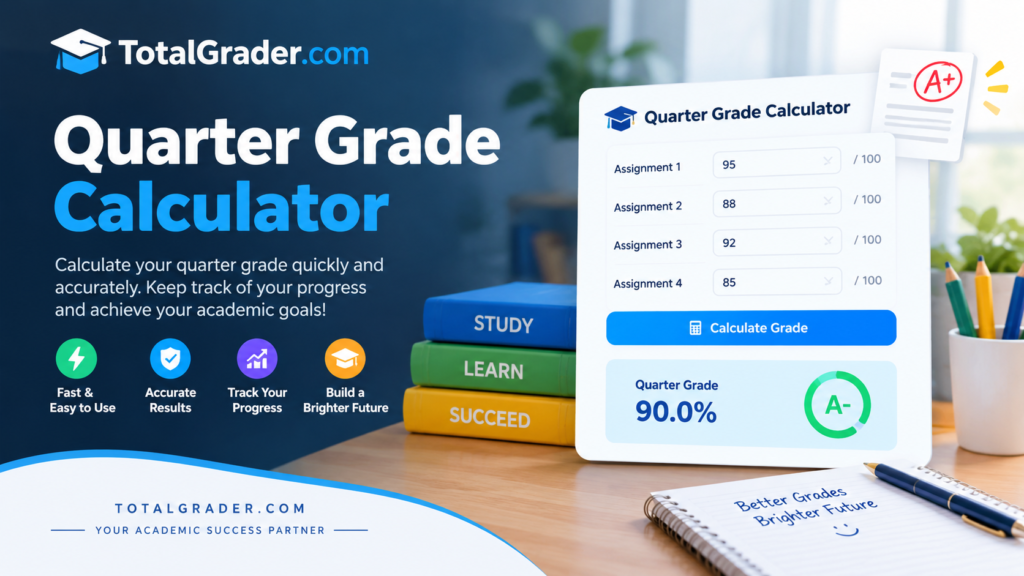
Quarter Grade Calculator
A Quarter Grade Calculator helps students quickly determine their grade for a grading period by combining scores from homework, quizzes, tests, projects, classwork, and other categories. Instead of calculating each weighted contribution manually, you can enter your scores and their corresponding weights to estimate your current quarter grade.
Quarter grades can be confusing because schools and teachers do not always use the same grading system. One class may count tests as 50% of the quarter grade, while another may give more weight to projects or assignments. Because of these differences, the most accurate calculation uses the grading weights provided by your teacher or school.
What Is a Quarter Grade Calculator?
A Quarter Grade Calculator is an online academic tool used to calculate a student’s overall grade for one grading period. It typically uses a weighted-average method in which each category contributes according to its assigned percentage.
For example, a teacher might calculate a quarter grade using:
- Homework: 15%
- Classwork: 20%
- Quizzes: 20%
- Tests: 30%
- Projects: 15%
The calculator combines your performance in each category according to these percentages and produces an overall quarter percentage.
This is different from simply adding all your grades and dividing by the number of assignments. When categories have different weights, a weighted calculation is required.
How Does a Quarter Grade Calculator Work?
The calculator generally follows a weighted-average formula:
Quarter Grade = Σ (Category Grade × Category Weight) ÷ Σ Category Weights
When all category weights add up to 100%, the calculation becomes straightforward.
For example, suppose you have:
| Category | Grade | Weight |
|---|---|---|
| Homework | 90% | 20% |
| Quizzes | 85% | 20% |
| Tests | 80% | 40% |
| Projects | 95% | 20% |
The calculation would be:
(90 × 0.20) + (85 × 0.20) + (80 × 0.40) + (95 × 0.20)
18 + 17 + 32 + 19 = 86%
Your calculated quarter grade would therefore be 86%.
The important part is that each grade is multiplied by the percentage representing how much that category contributes to the final quarter grade.
Why Use a Quarter Grade Calculator?
Calculating a weighted grade manually can become time-consuming when a class contains several grading categories. A calculator makes the process faster and reduces common arithmetic mistakes.
Students can use a quarter grade calculator to:
- Calculate their current quarter percentage
- Understand how different categories affect their grade
- Check a grade before receiving a report card
- Estimate how a future assignment could affect their average
- Understand the impact of tests and projects
- Compare their current performance with their target grade
- Check calculations from a gradebook
- Plan how to improve before the quarter ends
The calculator is especially useful when assignments do not all have the same importance.
How to Calculate Your Quarter Grade
You can calculate your quarter grade manually by following a few simple steps.
Step 1: Find Your Grading Categories
First, identify the categories used by your teacher.
Common categories include:
- Homework
- Classwork
- Quizzes
- Tests
- Projects
- Labs
- Participation
- Essays
- Presentations
Your course syllabus, grading policy, or online gradebook should show which categories are included.

Step 2: Find the Weight of Each Category
Next, determine how much each category contributes to the quarter grade.
For example:
- Homework = 15%
- Quizzes = 20%
- Tests = 40%
- Projects = 25%
The weights in a standard weighted system should represent the complete grading structure. Many calculators require the weights to total 100%.
Step 3: Enter Your Category Grades
Find your average for each category.
For example:
- Homework = 94%
- Quizzes = 86%
- Tests = 82%
- Projects = 90%
Step 4: Multiply Each Grade by Its Weight
Convert each percentage weight into decimal form:
- 15% = 0.15
- 20% = 0.20
- 40% = 0.40
- 25% = 0.25
Then multiply each category grade by its weight.
Step 5: Add the Weighted Contributions
Add all of the individual contributions together.
The resulting percentage represents your estimated quarter grade.
Quarter Grade Calculator Example
Consider a student with the following grades:
| Category | Grade | Weight | Contribution |
|---|---|---|---|
| Homework | 94% | 15% | 14.10 |
| Quizzes | 86% | 20% | 17.20 |
| Tests | 82% | 40% | 32.80 |
| Projects | 90% | 25% | 22.50 |
| Total | 100% | 86.60% |
The student’s weighted quarter grade is 86.6%.
Notice that the test category has the largest effect because tests account for 40% of the grade. Improving a heavily weighted category can have a greater effect on the overall result than improving a category with a smaller weight.
Weighted Grade vs. Simple Average
One of the most common grading mistakes is using a simple average when a class actually uses weighted categories.
Suppose your grades are:
- Homework: 95%
- Tests: 75%
A simple average would be:
(95 + 75) ÷ 2 = 85%
But suppose homework counts for 20% and tests count for 80%.
The weighted calculation becomes:
(95 × 0.20) + (75 × 0.80) = 79%
The difference is significant because the test category has a much greater effect on the quarter grade.
This is why knowing the actual category weights is essential.
What If My Grades Are Based on Points?
Some teachers do not use category weights. Instead, they calculate grades based on total points earned compared with total points possible.
For example:
- Assignment 1: 18/20
- Assignment 2: 45/50
- Test: 82/100
Total points earned:
18 + 45 + 82 = 145
Total points possible:
20 + 50 + 100 = 170
Your percentage would be:
145 ÷ 170 × 100 = 85.29%
This points-based system is different from category weighting. You should use the calculation method specified by your teacher or gradebook.
What Grade Do You Need to Improve Your Quarter Average?
A quarter grade calculator can also help you understand what score you may need on upcoming work.
For example, suppose your current weighted grade is 82% and you want to finish the quarter with at least 85%.
If an upcoming test represents a significant percentage of the remaining grade, the required score can be calculated from the current weighted points and the remaining weight.
A general formula is:
Required Score = (Target Grade − Current Weighted Points) ÷ Remaining Weight
The exact calculation depends on how much of the quarter has already been graded and how much the upcoming assessment contributes.
This type of planning is useful because it shows whether a particular target is mathematically achievable with the remaining assignments.
How Much Does a Test Affect Your Quarter Grade?
The effect of a test depends primarily on its assigned weight.
For example, if tests count for 40% of your quarter grade, improving your test average can have a substantial effect on your overall percentage.
Consider two students:
Student A
- Test average: 90%
- Test weight: 40%
Student B
- Test average: 75%
- Test weight: 40%
Even if both students perform similarly in homework and projects, the difference in their test averages can significantly affect their final quarter grades.
This is why students should look at both their scores and the weights attached to those scores.
How to Calculate a Quarter Grade Without a Calculator
If you do not have an online calculator, you can still calculate your grade manually.
Use this formula:
Quarter Grade = (Grade 1 × Weight 1) + (Grade 2 × Weight 2) + (Grade 3 × Weight 3) + …
For example:
- Homework: 90 × 0.20 = 18
- Quizzes: 85 × 0.20 = 17
- Tests: 80 × 0.40 = 32
- Projects: 95 × 0.20 = 19
Add the results:
18 + 17 + 32 + 19 = 86%
The quarter grade is 86%.
If the weights do not total 100%, you may need to divide the weighted total by the sum of the weights, depending on the grading system being used.

Quarter Grade Letter Conversion
After calculating your percentage, you can compare it with your school’s grading scale.
A commonly used U.S. percentage scale is:
| Percentage | Letter Grade |
|---|---|
| 90–100% | A |
| 80–89% | B |
| 70–79% | C |
| 60–69% | D |
| Below 60% | F |
However, these boundaries are not universal. Some schools and teachers use plus/minus grades or different percentage cutoffs. For an official grade, always follow the grading scale provided by your school or instructor.
Does Every School Use the Same Quarter Weights?
No. There is no single quarter-weighting system that applies to every school.
One school may use homework, quizzes, tests, and projects. Another may use points, standards-based grading, or a different combination of categories.
Even when two schools use the same categories, their percentages can be different.
For this reason, you should not assume that tests are always worth a particular percentage or that every quarter automatically counts for 25% of a year’s grade. Yearly and semester calculations depend on the school’s grading policy.
Quarter Grade vs. Semester Grade
A quarter grade represents one grading period, while a semester grade may combine multiple quarters and possibly an exam.
For example, a school might calculate a semester using:
- Quarter 1
- Quarter 2
- Final examination
The exact percentages depend on the school’s grading policy. Some systems use equal quarter weights, while others give an examination a separate percentage.
Therefore, a quarter grade calculator should not automatically be treated as a semester grade calculator.
Quarter Grade vs. Final Grade
These terms can also refer to different calculations.
A quarter grade generally covers a particular marking period. A final course grade may combine several grading periods across the semester or school year.
For example:
Quarter 1 → Quarter 2 → Quarter 3 → Quarter 4 → Final Year Grade
If each quarter contributes equally, a simple average may be appropriate. If the school assigns different weights, a weighted calculation is necessary.
Always check the official grading structure before calculating a final course result.
Common Mistakes When Calculating Quarter Grades
1. Treating Every Assignment as Equal
A test worth 40% should not be treated the same as homework worth 10%.
2. Using the Wrong Weight
Entering 20% instead of 30% can change the final calculation significantly.
3. Ignoring Missing Categories
If a grading category is part of the official grading system, leaving it out can produce an inaccurate result.
4. Confusing Points With Weights
A points-based system and a category-weighted system are not necessarily calculated the same way.
5. Assuming Every School Uses the Same Scale
Letter-grade boundaries and weighting policies can vary.
6. Rounding Too Early
Keep several decimal places during the calculation and round the final result. Rounding every intermediate value can create small errors.
Tips for Improving Your Quarter Grade
If your quarter grade is lower than your target, first identify which categories have the largest effect.
For example, if tests represent 50% of your grade, improving test performance may have a larger mathematical impact than improving a category worth 10%.
You can also:
- Review incorrect test questions
- Ask your teacher which topics need attention
- Complete eligible missing work
- Track upcoming assessments
- Review your grading policy
- Calculate different possible outcomes
- Focus on heavily weighted categories
- Check your grade regularly rather than waiting until the report card
The goal is not simply to look at the current percentage but to understand what is contributing to it.
Frequently Asked Questions
What is a quarter grade?
A quarter grade is the grade a student receives for a particular grading period. It may be calculated from homework, quizzes, tests, projects, classwork, or other categories.
How do I calculate my quarter grade?
Multiply each category grade by its assigned weight and add the weighted contributions together. If the weights total 100%, the result is your weighted quarter percentage.
What is the formula for a quarter grade?
The general formula is:
Quarter Grade = Σ (Category Grade × Category Weight) ÷ Σ Category Weights
When the category weights total 100%, the calculation can be performed directly using decimal weights.
Can I calculate my quarter grade from points?
Yes, if your teacher uses a points-based grading system. Add the points earned, divide them by the total possible points, and multiply by 100.
Is a quarter grade the same as a semester grade?
No. A quarter grade normally covers one grading period. A semester grade can combine multiple quarters and potentially exams or other components.
What if my teacher does not give category weights?
Ask your teacher or check the syllabus, student portal, or official grading policy. Do not assume that every category has equal importance.
Can a quarter grade calculator calculate my final year grade?
A basic quarter calculator focuses on one grading period. A separate year-grade calculation can combine multiple quarters using the weights established by your school.
Can I use a quarter grade calculator for high school?
Yes. A weighted quarter calculation can be useful for high school courses when the grading categories and weights are known.
Does a higher test grade always increase my quarter grade significantly?
Not necessarily. The effect depends on the test’s weight. A test worth 40% of the quarter generally has more influence than an assignment worth 5%, assuming the same grading structure.
Final Thoughts
A Quarter Grade Calculator provides a quick way to understand your performance during a grading period. The key is to use the actual grading categories and weights assigned by your teacher rather than relying on assumptions.
Whether your course uses homework, quizzes, tests, projects, classwork, or a points-based system, understanding how your grade is calculated can help you interpret your current performance and plan for upcoming assessments.
For the most accurate result, verify your school’s grading policy, enter your scores carefully, and use the calculator as a planning and checking tool rather than as a replacement for the official grade reported by your school.