
Quiz Grade Calculator With Number Wrong
A Quiz Grade Calculator With Number Wrong helps students quickly determine their quiz percentage and grade when they know how many questions they answered incorrectly. Instead of calculating the result manually, you can use the number of questions, the number wrong, or the number correct to find your score.
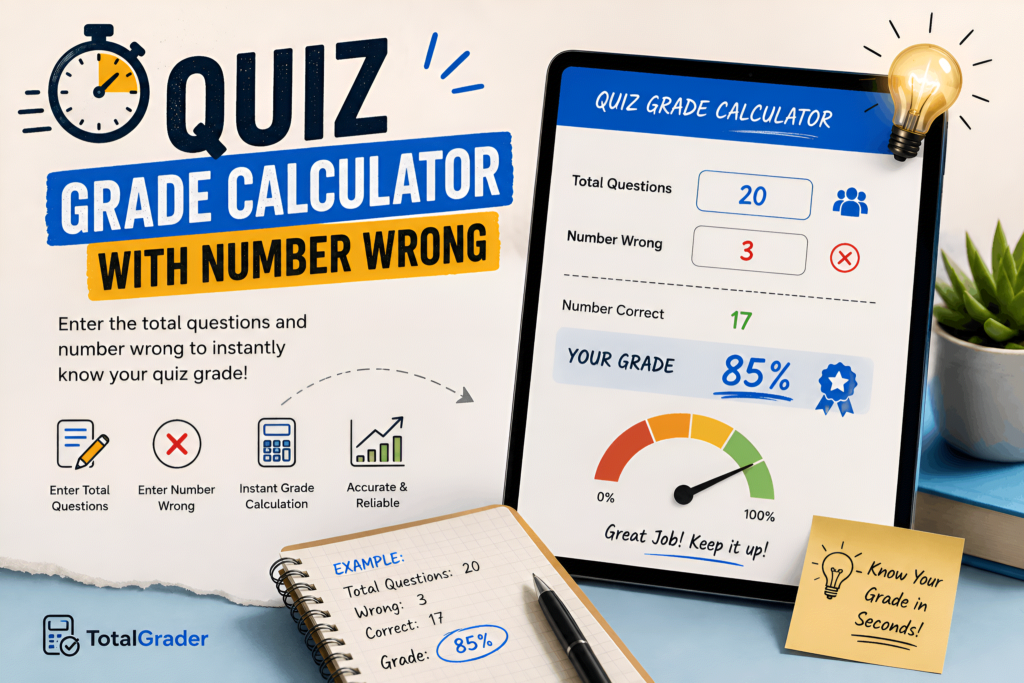
For example, if a quiz contains 20 questions and you get 3 wrong, you answered 17 correctly. Your quiz score is:
17 ÷ 20 × 100 = 85%
Knowing your quiz percentage can help you understand your current academic performance, estimate your letter grade, and determine how well you are doing before your teacher posts the final result.
What Is a Quiz Grade Calculator With Number Wrong?
A Quiz Grade Calculator With Number Wrong is a simple academic calculator that determines your quiz score based on the total number of questions and the number of questions you got wrong.
The basic calculation is:
Quiz Percentage = (Total Questions − Questions Wrong) ÷ Total Questions × 100
You can use this calculation for quizzes, tests, classroom assessments, practice exams, and other situations where each question has the same point value.
Example
Suppose your quiz has:
- Total questions: 25
- Questions wrong: 4
First, find the number of correct answers:
25 − 4 = 21 correct answers
Then calculate the percentage:
21 ÷ 25 × 100 = 84%
Your quiz score is 84%.
How Does the Quiz Grade Calculator Work?
The calculator follows a straightforward process.
Step 1: Enter the Total Number of Questions
Start by entering how many questions are on the quiz.
For example:
Total questions = 30
Step 2: Enter the Number of Questions Wrong
Next, enter how many questions you answered incorrectly.
For example:
Questions wrong = 6
Step 3: Find the Number Correct
Subtract the number wrong from the total number of questions:
30 − 6 = 24
You answered 24 questions correctly.
Step 4: Calculate Your Percentage
Divide the correct answers by the total number of questions and multiply by 100:
24 ÷ 30 × 100 = 80%
Your quiz grade is therefore 80%.
Quiz Grade Formula With Number Wrong
The most useful formula is:
Quiz Grade Percentage = [(Total Questions − Number Wrong) ÷ Total Questions] × 100
Where:
- Total Questions = the total number of questions on the quiz
- Number Wrong = the number of questions answered incorrectly
- Total Questions − Number Wrong = the number of correct answers
Another way to write the formula
You can also calculate the percentage you lost and subtract it from 100:
Percentage Wrong = Number Wrong ÷ Total Questions × 100
Then:
Quiz Grade = 100 − Percentage Wrong
For example, if you have 50 questions and get 5 wrong:
5 ÷ 50 × 100 = 10% wrong
Then:
100 − 10 = 90%
Your quiz grade is 90%.

Quiz Grade Calculator With Number Wrong Examples
Understanding several examples makes the calculation easier.
Example 1: 10 Questions, 1 Wrong
You have a 10-question quiz and miss 1 question.
Correct answers:
10 − 1 = 9
Percentage:
9 ÷ 10 × 100 = 90%
Quiz grade: 90%
Example 2: 20 Questions, 2 Wrong
Total questions:
20
Wrong answers:
2
Correct answers:
20 − 2 = 18
Percentage:
18 ÷ 20 × 100 = 90%
Quiz grade: 90%
Example 3: 20 Questions, 5 Wrong
Correct answers:
20 − 5 = 15
Percentage:
15 ÷ 20 × 100 = 75%
Quiz grade: 75%
Example 4: 25 Questions, 3 Wrong
Correct answers:
25 − 3 = 22
Percentage:
22 ÷ 25 × 100 = 88%
Quiz grade: 88%
Example 5: 50 Questions, 7 Wrong
Correct answers:
50 − 7 = 43
Percentage:
43 ÷ 50 × 100 = 86%
Quiz grade: 86%
Example 6: 100 Questions, 12 Wrong
Correct answers:
100 − 12 = 88
Percentage:
88 ÷ 100 × 100 = 88%
Quiz grade: 88%
When a test contains 100 questions, the calculation is especially easy because the number correct directly represents the percentage.
Quiz Grade Chart: Number Wrong and Percentage
The effect of a wrong answer depends on the total number of questions.
For a 10-question quiz:
- 0 wrong = 100%
- 1 wrong = 90%
- 2 wrong = 80%
- 3 wrong = 70%
- 4 wrong = 60%
- 5 wrong = 50%
- 6 wrong = 40%
- 7 wrong = 30%
- 8 wrong = 20%
- 9 wrong = 10%
- 10 wrong = 0%
For a 20-question quiz:
- 0 wrong = 100%
- 1 wrong = 95%
- 2 wrong = 90%
- 3 wrong = 85%
- 4 wrong = 80%
- 5 wrong = 75%
- 6 wrong = 70%
- 7 wrong = 65%
- 8 wrong = 60%
- 9 wrong = 55%
- 10 wrong = 50%
This shows why the total number of questions matters. One incorrect answer has a much larger effect on a short quiz than on a longer exam.
How Many Questions Can You Get Wrong and Still Get a 90%?
To determine how many questions you can miss while maintaining a particular percentage, use:
Maximum Wrong = Total Questions × (1 − Desired Percentage)
For a 20-question quiz and a target of 90%:
20 × (1 − 0.90) = 2
You can get 2 questions wrong and still receive 90%.
For a 50-question quiz:
50 × 0.10 = 5
You can get 5 questions wrong and receive 90%.
For a 100-question quiz:
100 × 0.10 = 10
You can get 10 questions wrong and receive 90%.
Because the number of questions must be a whole number, some combinations require rounding carefully. If your goal is to achieve at least a particular percentage, you should round the allowable number of wrong answers down.
How Many Questions Can You Get Wrong for an 80%?
An 80% score means you answered 80% of the questions correctly and missed 20%.
For a 25-question quiz:
25 × 20% = 5
So you can get 5 questions wrong and score 80%.
For a 30-question quiz:
30 × 20% = 6
You can get 6 questions wrong and score 80%.
For a 40-question quiz:
40 × 20% = 8
You can get 8 questions wrong and score 80%.
For a 50-question quiz:
50 × 20% = 10
You can get 10 questions wrong and score 80%.
How Many Questions Can You Get Wrong for a 70%?
A 70% score means 30% of the questions were incorrect.
For example, on a 20-question quiz:
20 × 30% = 6
Therefore, you can get 6 questions wrong and receive 70%.
On a 50-question quiz:
50 × 30% = 15
You can get 15 questions wrong and receive 70%.
Does the Number of Questions Affect Your Grade?
Yes. The number of questions can significantly affect how much each mistake changes your percentage.
If a quiz has only 10 questions, each question represents:
100 ÷ 10 = 10 percentage points
Therefore, getting one question wrong lowers your score by 10 percentage points.
If a quiz has 100 questions, each question represents:
100 ÷ 100 = 1 percentage point
So one incorrect answer lowers your score by only 1 percentage point.
This is why students should always consider the total number of questions when estimating their quiz grade.
What If the Quiz Has Different Point Values?
The basic Quiz Grade Calculator With Number Wrong assumes that every question is worth the same number of points.
However, some quizzes assign different point values to different questions.
For example:
- Multiple-choice question = 1 point
- Short-answer question = 2 points
- Essay question = 5 points
In this situation, simply counting the number of questions wrong may not produce the correct percentage.
Instead, you need to calculate your points earned compared with the total points available:
Percentage = Points Earned ÷ Total Points × 100
For example, if a quiz is worth 40 points and you earn 34 points:
34 ÷ 40 × 100 = 85%
Your score is 85%.
If your quiz contains questions with different values, use the total points rather than only the number of questions.
What If There Is Negative Marking?
Some exams deduct points for incorrect answers. In that situation, the standard number-wrong formula may not accurately represent your score.
For example, suppose:
- Correct answer = +1 point
- Wrong answer = −0.25 point
- Unanswered = 0 points
Your final score must account for the penalty applied to incorrect answers.
The calculation could be:
Score = Correct Points − Wrong Answer Penalties
Then convert that score into a percentage based on the applicable scoring system.
Always check your teacher’s or testing organization’s grading rules before calculating a final result.
What If I Leave Questions Blank?
A blank question is not always treated the same way as an incorrect answer.
In many standard quizzes, an unanswered question receives zero points, just like an incorrect answer. However, some exams use special scoring systems.
If blank questions receive zero points and there is no negative marking, you can calculate your percentage using the number of correct answers:
Percentage = Correct Answers ÷ Total Questions × 100
For example:
- Total questions = 40
- Correct = 32
- Wrong = 5
- Blank = 3
Your percentage is:
32 ÷ 40 × 100 = 80%
The five wrong and three blank questions together account for the eight questions you did not answer correctly.
How to Convert a Quiz Percentage to a Letter Grade
Letter-grade systems vary between schools, colleges, teachers, and countries. Therefore, you should use the grading scale provided by your school or instructor.
A commonly used example is:
- 90–100% = A
- 80–89% = B
- 70–79% = C
- 60–69% = D
- Below 60% = F
Using this example, an 85% quiz score would be a B.
However, another school may use plus and minus grades or a different grading scale. Always check the grading policy that applies to your course.

Why Use a Quiz Grade Calculator?
Calculating your quiz score manually is possible, but a calculator can make the process faster.
1. Saves Time
You do not need to perform the formula manually every time you want to check your score.
2. Reduces Calculation Errors
A calculator can reduce simple arithmetic mistakes when determining your percentage.
3. Helps You Understand Your Performance
Knowing your percentage gives you a clearer picture of how well you performed.
4. Makes Grade Planning Easier
You can use your quiz percentage when estimating your overall course performance, provided your course uses a grading system where quiz scores contribute to the final grade.
5. Useful for Different Quiz Sizes
Whether your quiz has 5, 10, 20, 50, or 100 questions, the same basic calculation can be applied when each question has equal value.
Common Mistakes When Calculating Quiz Grades
Students often make simple errors when calculating their scores.
Mistake 1: Using Wrong Answers as the Score
If you get 4 questions wrong out of 20, your score is not 20%.
You need to find the correct answers first:
20 − 4 = 16
Then:
16 ÷ 20 × 100 = 80%
Mistake 2: Forgetting to Divide by Total Questions
Simply subtracting wrong answers from 100 does not work unless the quiz contains exactly 100 equally weighted questions.
The correct formula is:
Correct Answers ÷ Total Questions × 100
Mistake 3: Ignoring Different Point Values
If questions have different point values, counting questions alone may give you an inaccurate result.
Use total points when the assessment is point-based.
Mistake 4: Assuming Every School Uses the Same Letter Grades
An 85% may correspond to a B under one grading scale but could be assigned differently under another.
Always check your course’s grading policy.
Mistake 5: Ignoring Negative Marking
If incorrect answers result in penalties, the standard formula may not apply.
Check the exam’s scoring rules before calculating your final score.
Quiz Grade Calculator With Number Wrong vs. Number Correct
Both methods can be used to calculate a quiz percentage.
If you know the number correct:
Percentage = Correct Answers ÷ Total Questions × 100
If you know the number wrong:
Percentage = (Total Questions − Wrong Answers) ÷ Total Questions × 100
For example, on a 30-question quiz:
- Correct = 24
- Wrong = 6
Using correct answers:
24 ÷ 30 × 100 = 80%
Using wrong answers:
(30 − 6) ÷ 30 × 100 = 80%
Both methods produce the same result.
How to Improve Your Quiz Score
A calculator tells you your result, but it does not improve your performance by itself. After receiving your quiz grade, use it to identify areas that need attention.
Review Incorrect Questions
Go through every question you missed. Determine whether the problem was a lack of knowledge, misunderstanding, careless reading, or a calculation error.
Create a Mistake List
Keep track of concepts you repeatedly miss. Reviewing these areas can make your study sessions more focused.
Practice Similar Questions
If you missed a particular type of question, practice several similar examples rather than reviewing only the original question.
Study Before the Quiz
Short, consistent study sessions can be more manageable than trying to learn everything immediately before an assessment.
Ask for Clarification
If you do not understand why an answer was incorrect, ask your teacher or instructor for an explanation.
Frequently Asked Questions
What is the formula for a quiz grade with number wrong?
The formula is:
Quiz Grade = (Total Questions − Questions Wrong) ÷ Total Questions × 100
This works when every question has the same value and there is no special penalty for incorrect answers.
What is 1 wrong out of 10?
If you get 1 wrong out of 10:
9 ÷ 10 × 100 = 90%
Your score is 90%.
What is 2 wrong out of 20?
You have 18 correct answers:
18 ÷ 20 × 100 = 90%
Your score is 90%.
What is 3 wrong out of 25?
You have 22 correct answers:
22 ÷ 25 × 100 = 88%
Your score is 88%.
What is 5 wrong out of 20?
You have 15 correct answers:
15 ÷ 20 × 100 = 75%
Your score is 75%.
What is 5 wrong out of 50?
You have 45 correct answers:
45 ÷ 50 × 100 = 90%
Your score is 90%.
What is 10 wrong out of 50?
You have 40 correct answers:
40 ÷ 50 × 100 = 80%
Your score is 80%.
What is 10 wrong out of 100?
You have 90 correct answers:
90 ÷ 100 × 100 = 90%
Your score is 90%.
Can I use this calculator for tests?
Yes, if the test uses equally weighted questions and does not have special scoring rules. If questions have different point values or negative marking, calculate the score using the test’s point system.
Does one wrong answer always reduce my grade by the same amount?
No. The effect depends on the total number of questions. One wrong answer has a larger percentage impact on a 10-question quiz than on a 100-question test.
Can I calculate my grade if I only know the number wrong?
Yes. If you know both the total number of questions and the number wrong, you can calculate the number correct and then determine the percentage.
Is an 80% a good quiz grade?
An 80% is often considered a good passing score, but whether it is considered good depends on your school’s grading scale, course requirements, and personal academic goals.
Final Thoughts
A Quiz Grade Calculator With Number Wrong provides a quick way to turn the number of incorrect answers into a percentage score. The basic process is simple: subtract the number wrong from the total number of questions, divide the result by the total questions, and multiply by 100.
The most important formula to remember is:
Quiz Percentage = [(Total Questions − Number Wrong) ÷ Total Questions] × 100
For example, if you miss 4 questions on a 25-question quiz:
(25 − 4) ÷ 25 × 100 = 84%
Your quiz score is 84%.
For the most accurate result, make sure you know whether every question has equal value and whether your quiz uses penalties for incorrect answers. If the assessment uses different point values, calculate your grade from points earned and total points instead.
A quiz calculator is most useful when combined with good study habits. After calculating your score, review the questions you missed, identify weak areas, and use that information to prepare for your next assessment.