
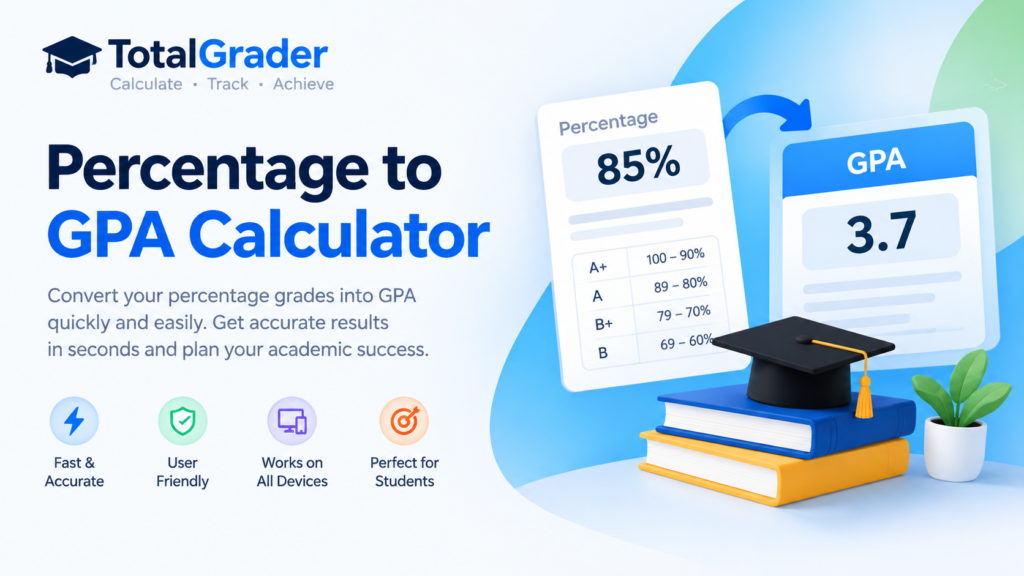
Percentage to GPA Calculator
Getting your academic results in percentage form is common in many schools and educational systems. However, when you apply to a college, university, or scholarship program, you may be asked to provide your Grade Point Average (GPA) instead. This can create confusion, especially if you are unfamiliar with GPA grading scales.
A Percentage to GPA Calculator makes this process easier by helping you estimate your GPA from your percentage score. Instead of trying to understand complicated grading charts, you can enter your percentage and use a suitable conversion method to find an estimated result.
For example, if you scored 85% in your examinations, you might want to know what that result represents on a 4.0 GPA scale. An online calculator can help you understand the conversion quickly.
In this guide, we will explain how percentage-to-GPA conversion works, discuss different grading scales, provide practical examples, and show you what to consider before using your converted result for academic applications.
What Is a Percentage to GPA Calculator?
A Percentage to GPA Calculator is an online academic tool that helps students estimate their Grade Point Average from a percentage-based result.
Percentage grading expresses academic performance as a number out of 100. GPA, on the other hand, represents academic performance using a numerical grade-point system. Educational institutions may use different GPA scales, including 4.0, 5.0, and 10.0.
For example, a student who receives 90% may want to understand how that score compares with a 4.0 GPA grading system.
The calculator helps simplify this process by applying a selected conversion formula or grading chart. Depending on the tool, students may enter their percentage, select a grading scale, and receive an estimated GPA.
It is important to remember that percentage-to-GPA conversion is not universal. Different schools and universities can assign different GPA values to the same percentage score.
How to Convert Percentage to GPA
There are different ways to convert percentages into GPA values. The simplest mathematical approach is to use a proportional formula.
Basic formula:
GPA = (Percentage ÷ 100) × Maximum GPA
For example, suppose a student receives 80% and wants to estimate their result on a 4.0 scale.
The calculation is:
GPA = (80 ÷ 100) × 4.0
GPA = 3.2
Therefore, using this proportional formula, 80% equals an estimated 3.2 GPA on a 4.0 scale.
However, this is only a mathematical estimate. Many educational institutions use letter-grade boundaries or official conversion tables instead of direct proportional calculations.
If you are converting grades for an official application, always check the institution’s requirements.

Percentage to GPA Conversion Chart
A conversion chart provides a quick reference for students who want to understand how different percentage scores compare with a 4.0 GPA scale.
The following table uses the proportional formula to provide estimated GPA values.
| Percentage | Estimated GPA (4.0 Scale) |
|---|---|
| 50% | 2.00 |
| 55% | 2.20 |
| 60% | 2.40 |
| 65% | 2.60 |
| 70% | 2.80 |
| 75% | 3.00 |
| 80% | 3.20 |
| 85% | 3.40 |
| 90% | 3.60 |
| 95% | 3.80 |
| 100% | 4.00 |
Important: This is a proportional conversion reference, not an official university grading chart. Actual GPA results can vary according to institutional grading policies.
How to Use a Percentage to GPA Calculator
Using an online percentage conversion calculator is simple. You only need your percentage result and the grading scale you want to use.
Follow these steps to understand the process:
Step 1: Find Your Percentage Score
First, identify your overall percentage from your academic results. For example, you might have received 82% in your examinations.
Make sure you are using the correct overall percentage rather than an individual assignment or examination score.
Step 2: Select Your GPA Scale
Choose the GPA scale you want to understand. A 4.0 scale is commonly used in the United States, although some institutions use other grading systems.
Step 3: Enter Your Percentage
Enter your percentage into the calculator. For example, if your result is 82, enter 82 rather than 0.82.
Step 4: Calculate Your Estimated GPA
Select the calculate option to process your result. The calculator will apply its conversion method and display an estimated GPA.
Step 5: Review Your Result
Check the result and compare it with your school’s official grading policy if you need the conversion for an academic application.
Using TotalGrader’s educational calculators can make everyday academic calculations easier and help you understand your results.
Percentage to GPA Conversion for Different GPA Scales
Not all educational institutions use the same grading scale. Understanding the maximum GPA is important because the conversion formula changes depending on the selected scale.
Here are some examples using proportional conversion.
Percentage to GPA on a 4.0 Scale
The 4.0 grading scale is commonly used by colleges and universities in the United States.
Suppose you received 85%.
Using the proportional formula:
GPA = (85 ÷ 100) × 4.0
GPA = 3.40
Therefore, 85% gives an estimated 3.40 GPA under this calculation method.
Percentage to GPA on a 5.0 Scale
Some educational institutions use a 5.0 grading scale. This may be associated with grading systems that provide additional points for certain advanced courses.
For example, if your percentage is 80%:
GPA = (80 ÷ 100) × 5.0
GPA = 4.0
The estimated result is 4.0 on a 5.0 scale.
Percentage to GPA on a 10.0 Scale
Some international educational systems use a 10-point grading scale.
Suppose your percentage is 90%.
GPA = (90 ÷ 100) × 10.0
GPA = 9.0
This gives an estimated GPA of 9.0 on a 10.0 scale.
These examples demonstrate how the proportional formula works. However, an institution may use a completely different conversion policy.
What Is the Difference Between Percentage and GPA?
Percentage and GPA are two different ways of describing academic performance.
A percentage represents the marks earned compared with the total available marks. For example, receiving 85 marks out of 100 means your percentage is 85%.
GPA represents academic performance using numerical grade points. It may be calculated using letter grades, course credits, and the grading rules established by an educational institution.
Here is a simple comparison:
| Feature | Percentage | GPA |
|---|---|---|
| Format | Out of 100 | Grade points |
| Example | 85% | 3.4 |
| Calculation | Marks earned ÷ total marks × 100 | Depends on grading policy |
| Common use | School examinations | College and university records |
| Grading system | Percentage-based | GPA-based |
Although these systems are related, they do not always produce a direct one-to-one conversion.
For example, two universities may assign different GPA values to students who receive the same percentage because their grading boundaries are different.
Why Do Students Convert Percentage Into GPA?
Students convert percentages into GPA for several academic reasons. This is particularly useful when they move between educational systems or prepare applications for institutions that use different grading formats.
1. College and University Admissions
Many students apply to colleges or universities that request academic information in GPA format.
If your previous school reports results using percentages, understanding the approximate GPA can help you prepare your academic information.
However, always follow the admission department’s instructions. Some institutions calculate GPA themselves and do not require applicants to perform their own conversion.
2. Scholarship Applications
Some scholarships have academic eligibility requirements based on GPA. Students with percentage-based results may want to estimate their GPA before checking whether they meet the required academic criteria.
Remember that scholarship providers may use their own evaluation methods.
3. Studying in Another Country
Students planning to study internationally often encounter different grading systems.
For example, someone who completed their education using percentage-based grading may need to understand the GPA system used by a university in the United States.
A conversion calculator can provide a starting point, although official academic evaluations may require additional documentation.
4. Understanding Academic Performance
Some students simply prefer seeing their results in different formats.
Converting percentage into GPA can provide another perspective on academic performance and help students understand the grading systems used by different educational institutions.
What Percentage Is Considered a Good GPA?
A good academic result depends on the educational institution, course difficulty, grading policy, and academic requirements.
On a percentage-based grading system, higher percentages generally represent stronger examination performance. However, there is no universal percentage that automatically corresponds to a particular GPA at every university.
For example, an institution may consider 90% an A grade, while another may have different grade boundaries.
Students should avoid comparing percentages and GPAs without understanding the grading rules behind them.
If you are applying to a university, review its published admission requirements to understand how academic performance is evaluated.
Is 90% Equal to a 4.0 GPA?
Not necessarily. The answer depends on the grading policy used by the educational institution.
Using a simple proportional formula on a 4.0 scale:
GPA = (90 ÷ 100) × 4.0
GPA = 3.6
Therefore, the proportional estimate is 3.6 GPA.
However, some institutions use letter-grade conversion tables. If 90% falls within their A-grade range, they may assign a GPA of 4.0.
This is an important distinction. A proportional mathematical estimate and an official institutional conversion are not always the same.

Common Mistakes When Converting Percentage to GPA
Although the conversion process may look simple, students can make mistakes that affect their results.
Here are some common issues to avoid.
1. Selecting the Wrong GPA Scale
Always check whether your institution uses a 4.0, 5.0, or 10.0 scale. Applying the wrong scale will produce an incorrect estimate.
2. Assuming Every Institution Uses the Same Formula
Different schools and universities can have different grading boundaries. Never assume that a conversion method used by one institution will work everywhere.
3. Confusing Course Percentage With Overall Percentage
A single examination result may not represent your complete academic performance. Check whether you need to convert an individual course grade or your overall academic percentage.
4. Ignoring Institutional Grading Policies
Some institutions calculate GPA using credit hours and letter grades. A simple percentage formula may not reflect their actual calculation method.
5. Treating an Estimated GPA as an Official Result
An online calculator provides a mathematical estimate based on its selected formula. It does not replace an official transcript or university evaluation.
Tips for Getting a More Reliable GPA Conversion
Before using your converted GPA in an academic application, consider these helpful points:
- Check your original academic transcript.
- Identify the grading scale used by your institution.
- Select a conversion method appropriate for your educational system.
- Review official university admission guidelines.
- Keep your original percentage results available.
- Avoid rounding your GPA unnecessarily.
- Contact the admissions department if the required conversion method is unclear.
These steps can help you avoid misunderstandings when comparing academic results.
Frequently Asked Questions
1. How do I convert percentage to GPA?
A simple proportional method is to divide your percentage by 100 and multiply it by the maximum GPA scale. For example, 80% on a 4.0 scale gives an estimated GPA of 3.2.
2. What is 80% in GPA?
Using proportional conversion on a 4.0 scale, 80% equals an estimated GPA of 3.2. However, the official result may vary between institutions.
3. What is 85% in GPA?
On a 4.0 scale, 85% equals an estimated GPA of 3.4 using the proportional formula. Some universities may assign a different value through their grading tables.
4. What is 90% in GPA?
Using proportional conversion, 90% equals an estimated 3.6 GPA on a 4.0 scale. An institution using letter-grade boundaries may assign a different value.
5. Is 75% a 3.0 GPA?
Using the proportional formula on a 4.0 scale, 75% equals an estimated GPA of 3.0. The official equivalency depends on the grading policy.
6. Can I convert percentage to GPA on a 10.0 scale?
Yes. If you use proportional conversion, divide your percentage by 100 and multiply by 10. For example, 80% gives an estimated GPA of 8.0.
7. Is percentage to GPA conversion the same worldwide?
No. Educational institutions use different grading systems and conversion policies. The same percentage may produce different GPA results depending on the institution.
8. Can I use a percentage-to-GPA calculator for university admission?
You can use an online calculator to understand your estimated GPA. However, universities may require official transcripts, their own conversion methods, or an independent academic evaluation.
Final Thoughts
Understanding the relationship between percentages and GPA can make academic planning easier, especially when applying to colleges, universities, or scholarship programs.
A Percentage to GPA Calculator helps students estimate their grade points without performing repeated calculations manually. Whether you have received 70%, 80%, 85%, or 95%, the right conversion method can help you understand how your result compares with a selected GPA scale.
However, remember that a mathematical estimate is not necessarily an official academic equivalency. Always check your institution’s grading policy when accuracy is important.
Explore TotalGrader for more useful academic calculators designed to make grade calculations easier and help students understand their educational results.