
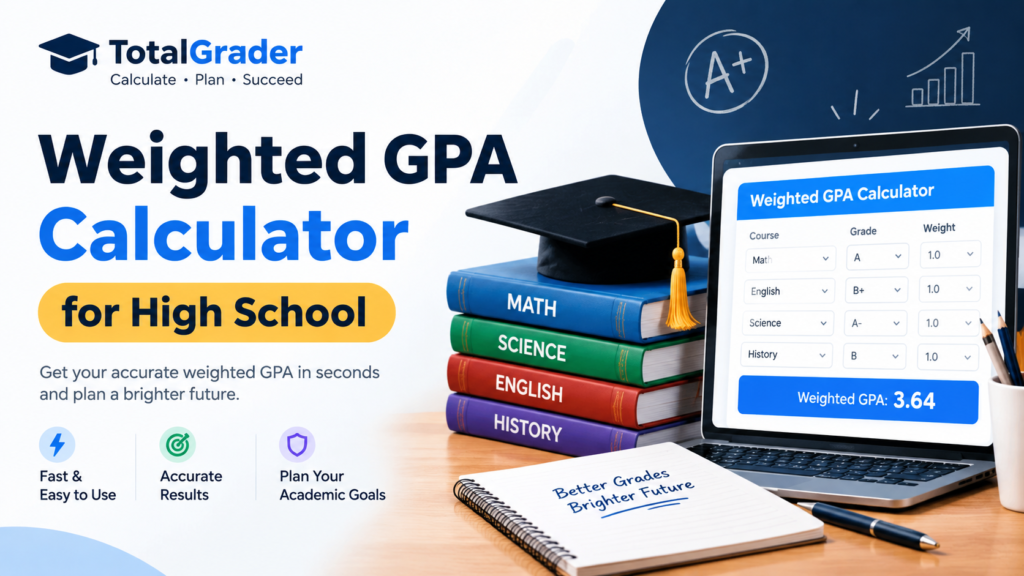
Weighted GPA Calculator for High School
High school students do not always take courses with the same level of difficulty. Some classes follow a regular curriculum, while others offer more challenging academic work through Advanced Placement (AP), International Baccalaureate (IB), or Honors programs. Because of these differences, some schools use a weighted GPA system to recognize students who complete advanced coursework.
A Weighted GPA Calculator for High School helps students estimate their grade point average by considering both their grades and the difficulty of their classes. Unlike a standard GPA calculation, a weighted system may award additional grade points for approved advanced courses.
For example, an A in a regular class might receive 4.0 points, while an A in an approved AP course could receive 5.0 points under a particular school’s grading policy.
Understanding this system can help students review their academic progress, plan future classes, and understand how challenging courses may affect their overall GPA.
In this guide, you will learn how weighted GPA works, how to calculate it manually, how AP and Honors courses can affect your results, and what to check before using your GPA for college applications.
What Is a Weighted GPA Calculator for High School?
A Weighted GPA Calculator for High School is an online academic tool that helps students estimate their grade point average while accounting for the difficulty of their courses.
In a regular GPA system, schools generally assign grade points according to the letter grades students earn. A weighted GPA system may provide additional points for approved advanced classes.
These classes can include:
- Advanced Placement (AP) courses
- Honors classes
- International Baccalaureate (IB) courses
- Dual enrollment classes
- Other advanced academic programs recognized by the school
The additional points are not automatically available at every school. Each high school establishes its own weighting rules, including which courses qualify and how many extra points are awarded.
A weighted GPA calculator makes it easier to apply those rules and estimate your academic standing without manually calculating every course.
What Is a Weighted GPA?
A weighted GPA is a grade point average that considers the academic level of the courses a student completes.
The main purpose is to recognize students who take more challenging classes. For example, a student enrolled in several AP courses may receive additional grade points compared with a student taking only regular-level classes, assuming both students earn similar letter grades.
Consider this simplified example:
| Course Type | Grade | Example GPA Points |
|---|---|---|
| Regular English | A | 4.0 |
| Honors Mathematics | A | 4.5 |
| AP Biology | A | 5.0 |
These values represent one illustrative weighting system. Your school may use a different scale.
A weighted GPA can therefore be higher than an unweighted GPA, even when the student’s actual letter grades remain unchanged.

Weighted GPA vs. Unweighted GPA
Understanding the difference between weighted and unweighted GPA is important because high schools may report both values on academic transcripts.
An unweighted GPA generally evaluates grades without adding extra points for advanced coursework. A weighted GPA may recognize the additional difficulty of approved classes.
Here is a simple comparison:
| Feature | Weighted GPA | Unweighted GPA |
|---|---|---|
| Course difficulty | May be considered | Generally not considered |
| AP classes | May receive extra points | No additional points |
| Honors classes | May receive extra points | No additional points |
| Common scale | Often 4.5 or 5.0, depending on school | Often 4.0 |
| Main purpose | Recognizes advanced coursework | Measures grades without course weighting |
For example, imagine two students receive an A in every class. One takes regular-level courses, while the other completes several approved AP and Honors courses.
Their unweighted GPAs may be identical, but their weighted GPAs could be different because of the additional course points.
Neither number tells the complete story of a student’s academic ability. Colleges may review both GPAs alongside course selection, grades, and the school’s grading system.
How to Calculate Weighted GPA
Calculating weighted GPA involves finding the grade points assigned to each course, adding any applicable weighting points, and calculating the average.
A common calculation method is:
Weighted GPA = Total Weighted Grade Points ÷ Number of Courses
This simplified formula assumes that all courses carry equal weight. Schools that calculate GPA using credits require a credit-weighted calculation instead.
Step 1: Find Your Letter Grades
Start by collecting the final letter grades for all the courses included in your GPA.
For example:
- English: A
- Mathematics: B
- Biology: A
- History: B
Make sure you use the grades included in your school’s GPA calculation.
Step 2: Identify Each Course Level
Next, identify whether each course is regular, Honors, AP, IB, or another advanced class.
This information is important because additional grade points are only awarded when the course qualifies under your school’s weighting policy.
Step 3: Convert Letter Grades Into Grade Points
Use your school’s grade-point chart to convert each letter grade into numerical points.
For example, a school might use the following basic scale:
| Letter Grade | Regular Course Points |
|---|---|
| A | 4.0 |
| B | 3.0 |
| C | 2.0 |
| D | 1.0 |
| F | 0.0 |
This is a simplified example. Some schools use plus and minus grades, such as A-, B+, or C-.
Step 4: Add Course Weighting Points
If your school awards additional points for advanced courses, apply those points according to its official rules.
For example, a school might use this system:
- Regular course: No additional points
- Honors course: Add 0.5 points
- AP course: Add 1.0 point
Suppose you receive an A in an AP Biology class. The regular grade value is 4.0, and the additional AP weighting is 1.0.
Your weighted grade point becomes 5.0.
Step 5: Calculate Your Average
After calculating the weighted grade points for every course, add them together and divide by the number of equally weighted courses.
If your courses have different credit values, use the credit-weighted formula instead.
This gives you an estimated weighted GPA based on the grading rules you selected.
Weighted GPA Calculation Example
Let’s look at a practical example to understand the process more clearly.
Imagine a high school student completes five courses during a semester.
The school uses the following example weighting system:
- Regular courses: No additional points
- Honors courses: Additional 0.5 points
- AP courses: Additional 1.0 point
The student’s results are:
| Course | Course Level | Grade | Weighted Points |
|---|---|---|---|
| English | Regular | A | 4.0 |
| Algebra | Honors | B | 3.5 |
| Biology | AP | A | 5.0 |
| History | Regular | B | 3.0 |
| Chemistry | Honors | A | 4.5 |
Step 1: Add the weighted points.
4.0 + 3.5 + 5.0 + 3.0 + 4.5 = 20.0
Step 2: Count the courses.
The student completed five courses.
Step 3: Divide the total points by the number of courses.
Weighted GPA = 20.0 ÷ 5
Final Weighted GPA = 4.00
The student’s estimated weighted GPA is 4.00 under this example grading system.
This example demonstrates how advanced classes can change the GPA calculation even when students earn the same letter grades in different course levels.
How AP Classes Affect Weighted GPA
Advanced Placement courses are college-level classes offered to high school students through the AP program.
Some high schools award additional grade points for AP courses because they involve more advanced academic work.
For example, under a school policy that adds 1.0 point to AP courses:
| Letter Grade | Regular Points | AP Weighted Points |
|---|---|---|
| A | 4.0 | 5.0 |
| B | 3.0 | 4.0 |
| C | 2.0 | 3.0 |
| D | 1.0 | 2.0 |
| F | 0.0 | 0.0 |
This table is illustrative rather than universal. Some schools use different AP weighting rules or do not add an extra point for every AP class.
Taking AP courses can affect a student’s weighted GPA, but earning strong grades is still important. Students should consider their academic preparation and workload before choosing advanced classes.

How Honors Classes Affect Weighted GPA
Honors courses are designed to provide additional academic challenges compared with standard classes.
They may involve more detailed assignments, advanced reading, independent research, and deeper subject discussions.
Some high schools provide an additional 0.5 grade points for Honors classes.
For example, under that policy:
- A in a regular class = 4.0
- A in an Honors class = 4.5
- B in a regular class = 3.0
- B in an Honors class = 3.5
These examples show how Honors courses may influence a student’s weighted GPA.
However, not every school uses the same system. Check your school’s official course catalog or grading handbook to confirm which classes receive additional points.
How Credit Hours Affect Weighted GPA
Not every course carries the same number of credits. Some classes may be worth more credits than others, depending on the school’s academic structure.
When courses have different credit values, simply adding grade points and dividing by the number of classes may produce an inaccurate result.
Instead, use a credit-weighted formula:
Weighted GPA = Total (Grade Points × Course Credits) ÷ Total Course Credits
Consider this example:
| Course | Weighted Grade Points | Credits | Quality Points |
|---|---|---|---|
| English | 4.0 | 1.0 | 4.0 |
| Mathematics | 4.5 | 1.0 | 4.5 |
| AP Biology | 5.0 | 1.0 | 5.0 |
| History | 3.0 | 0.5 | 1.5 |
Total quality points = 15.0
Total credits = 3.5
Weighted GPA = 15.0 ÷ 3.5
Weighted GPA = 4.29
This method gives greater consideration to courses with higher credit values.
Always use the credit values and weighting rules provided by your school.
What Is a Good Weighted GPA in High School?
A good weighted GPA depends on the school’s grading scale, the difficulty of the courses, and the academic expectations of the colleges a student wants to attend.
For example, a 4.2 GPA may represent strong academic performance at a school that uses a 5.0 weighted scale. However, the same number may not have the same meaning at an institution using a different system.
Here are a few general considerations:
A GPA Above 4.0: At schools that award additional points for advanced coursework, a weighted GPA above 4.0 may indicate that a student has completed challenging classes and earned strong grades.
A GPA Around 3.5: This may represent solid academic performance, depending on the grading system and course selection.
A GPA Below 3.0: Students may want to review their course grades and identify subjects where additional academic support could help.
These are general observations, not universal admission standards. Colleges often consider the grading scale and course opportunities available at each high school.
Can Your Weighted GPA Be Higher Than 4.0?
Yes. A weighted GPA can exceed 4.0 when a school awards additional grade points for advanced coursework.
For example, a school may assign 4.0 points for an A in a regular class and 5.0 points for an A in an approved AP course.
If a student earns several strong grades in weighted courses, the overall GPA may become higher than 4.0.
However, not every school uses a weighted scale that allows values above 4.0. Some schools cap GPA values or apply different weighting policies.
Therefore, always check the maximum GPA permitted by your institution.
How to Improve Your Weighted GPA in High School
Students who want to improve their academic standing should focus on consistent performance rather than choosing advanced courses simply to increase their GPA.
Here are some practical approaches:
1. Build Strong Study Habits
Create a regular study schedule and give enough time to each subject. Reviewing lessons throughout the week can make it easier to understand difficult topics before examinations.
2. Choose Courses Carefully
Advanced classes may provide additional grade points, but they also require greater academic effort. Select courses that match your interests, preparation, and long-term educational goals.
3. Ask Teachers for Help
If you are struggling with a particular subject, speak with your teacher. Asking questions early can help you understand challenging material before it affects your final grade.
4. Complete Assignments on Time
Homework, projects, and classroom activities may contribute to your final course grades. Keeping track of deadlines can help you avoid missing important marks.
5. Monitor Your Academic Progress
Review your grades throughout the semester. A GPA calculator can help you understand how individual course results affect your overall academic average.
Weighted GPA and College Admissions
Many high school students are interested in weighted GPA because they want to understand how colleges evaluate academic performance.
However, college admissions are not based on one GPA number alone.
Universities may review:
- High school grades
- Course difficulty
- AP and Honors coursework
- Academic progress over time
- School grading policies
- Personal essays
- Extracurricular activities
- Other application requirements
Some colleges recalculate applicants’ GPAs using their own methods. Others evaluate students using the GPA reported by their high schools.
This means that a higher weighted GPA does not automatically guarantee admission.
Students should review the admissions policies of their preferred colleges and make sure they understand how academic records are evaluated.
Common Weighted GPA Calculation Mistakes
A small mistake in course weighting or grade-point selection can change the final GPA. Here are some errors students should avoid.
Using the Wrong Weighting Policy: Do not assume that every school adds 0.5 points for Honors or 1.0 point for AP courses. Use your institution’s actual rules.
Forgetting Course Credits: If classes have different credit values, a simple average may not be accurate.
Mixing Weighted and Unweighted Points: Keep regular grade points separate from additional course weighting until you apply the correct calculation.
Including Courses That Do Not Count: Some schools exclude particular courses from GPA calculations. Check which subjects are included.
Rounding Too Early: Calculate using the full values and round only when displaying the final result.
Frequently Asked Questions
1. What is a weighted GPA calculator for high school?
It is an online tool that helps high school students calculate their GPA while considering additional grade points assigned to approved advanced courses, such as AP and Honors classes.
2. How do I calculate my weighted GPA?
Convert your letter grades into grade points, apply the additional weighting assigned to eligible courses, add the points, and divide by the number of courses. If your classes have different credit values, use a credit-weighted calculation.
3. Is a 4.0 weighted GPA good?
A 4.0 weighted GPA can represent strong academic performance, but its meaning depends on the school’s grading scale and course weighting rules.
4. What is the difference between weighted and unweighted GPA?
An unweighted GPA generally measures grades without extra points for advanced courses. A weighted GPA may award additional points for AP, Honors, IB, and other approved classes.
5. Can I get a 5.0 weighted GPA?
Yes, if your high school uses a weighting system that allows students to earn up to 5.0 points in certain advanced courses. The maximum GPA depends on your school’s policies.
6. Do AP classes increase weighted GPA?
AP classes may increase weighted GPA when the high school awards additional grade points for them. The exact amount depends on the institution.
7. Do Honors classes count toward weighted GPA?
Many high schools include approved Honors classes in weighted GPA calculations. Some award extra points, while others use different grading policies.
8. Can I calculate weighted GPA without course credits?
Yes, if all your courses carry equal weight, you can calculate a simple average of their weighted grade points. If credits differ, you should use the credit-weighted formula.
9. Do colleges look at weighted or unweighted GPA?
Colleges may consider both. Some use the GPA reported by the high school, while others recalculate academic results according to their own admission policies.
10. Can my weighted GPA decrease?
Yes. Lower grades in new courses can reduce your overall GPA, even when some classes provide additional weighting points.
Final Thoughts
Calculating your weighted GPA can help you understand how your academic performance and course selection work together. Unlike an unweighted GPA, this system may recognize students who complete challenging classes by awarding additional grade points.
A Weighted GPA Calculator for High School makes the process easier by helping you organize course grades, apply the appropriate weighting rules, and estimate your overall academic average.
Before relying on a calculated result, remember to check your school’s official grading policy. Every institution may use different rules for AP, Honors, IB, and credit-based courses.
Explore TotalGrader for more useful academic calculators that help students understand their grades and make informed decisions about their education.