
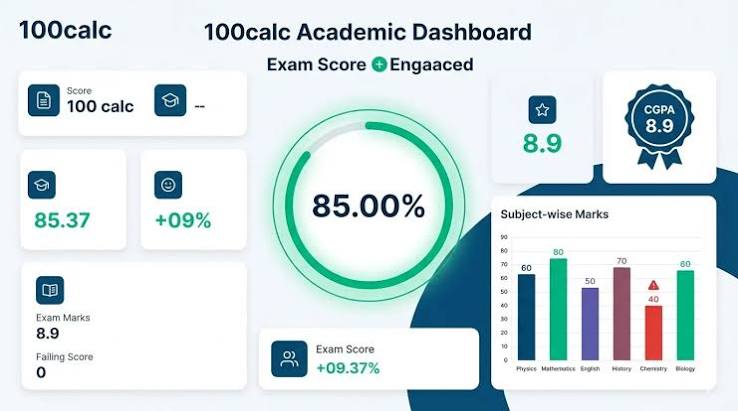
Exam Score Percentage Calculator: Calculate Your Exam Grade Easily
Exam Score Percentage Calculator
Knowing your exam percentage is one of the easiest ways to understand how well you performed on a test. Whether you are checking a practice exam, estimating your result before the official grade is released, or trying to understand your academic progress, an Exam Score Percentage Calculator can give you a quick and clear answer.
The basic calculation is simple when every question has the same value. You divide the number of points or questions you earned by the total possible points or questions, then multiply the result by 100.
For example, if you answer 42 questions correctly on a 50-question exam:
42 ÷ 50 × 100 = 84%
Your exam score is 84%.
However, not every exam uses exactly the same grading method. Some assessments contain questions worth different numbers of points, while others include partial credit, bonus marks, or penalties for incorrect answers. In those cases, you need to use the actual points earned rather than simply counting correct answers.
This guide explains how an exam score percentage calculator works, how to calculate percentages manually, how to convert scores into letter grades, and how to determine the score you need to reach a specific target.
What Is an Exam Score Percentage Calculator?
An Exam Score Percentage Calculator converts your raw exam result into a percentage.
The calculator typically uses two values:
- Points earned
- Total points possible
The standard formula is:
Exam Percentage = (Points Earned ÷ Total Points Possible) × 100
For example, if an exam is worth 80 points and you earn 68:
68 ÷ 80 × 100 = 85%
Your exam percentage is 85%.
When every question is worth the same amount, you can use the number of correct questions instead:
Exam Percentage = (Correct Answers ÷ Total Questions) × 100
Both methods produce the same result when each question has equal value.
How Does the Exam Score Percentage Calculator Work?
The calculation involves three basic steps.
Step 1: Find Your Earned Points
Determine how many points you received on the exam.
For example:
72 points earned
Step 2: Find the Total Possible Points
Check how many points the entire exam was worth.
For example:
80 points possible
Step 3: Calculate the Percentage
Use:
72 ÷ 80 × 100 = 90%
Your exam score is therefore 90%.
This calculation works whether the exam is worth 10 points, 50 points, 100 points, or several hundred points.
How to Calculate an Exam Percentage by Questions
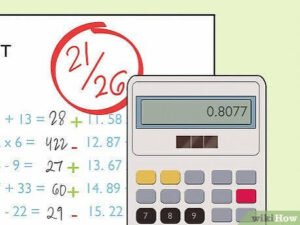
If every question is worth the same amount, you do not need to know the points.
Suppose your exam has 60 questions and you answer 51 correctly.
Use:
51 ÷ 60 × 100
This gives:
85%
Your exam score is 85%.
If you know how many questions you got wrong, first find the number correct:
Correct Answers = Total Questions − Questions Wrong
For example, on a 60-question exam, if you got 9 wrong:
60 − 9 = 51 correct
Then:
51 ÷ 60 × 100 = 85%
Exam Percentage Examples
Here are several common examples.
| Correct Answers | Total Questions | Percentage |
|---|---|---|
| 9 | 10 | 90% |
| 18 | 20 | 90% |
| 22 | 25 | 88% |
| 32 | 40 | 80% |
| 42 | 50 | 84% |
| 75 | 100 | 75% |
These examples assume every question has equal value and there are no penalties for incorrect answers.
What Percentage Is 45 Out of 50?
To calculate the percentage:
45 ÷ 50 × 100 = 90%
So, 45 out of 50 is 90%.
This is also useful for understanding how many questions you can miss. If you get 45 correct out of 50, you missed 5 questions.
What Percentage Is 40 Out of 50?
Calculate:
40 ÷ 50 × 100 = 80%
Therefore, 40 out of 50 is 80%.
Because the test contains 50 equally weighted questions, each question is worth 2 percentage points.
What Percentage Is 80 Out of 100?
When an exam has 100 possible points, the calculation is especially easy.
80 ÷ 100 × 100 = 80%
So, 80 out of 100 is 80%.
In fact, when the total possible score is 100, your raw score and percentage are numerically the same.
What Percentage Is 37 Out of 40?
Use:
37 ÷ 40 × 100 = 92.5%
Therefore, 37 out of 40 is 92.5%.
If your school rounds grades to the nearest whole number, this may become 93%, depending on the institution’s grading policy.
Why Is Calculating Your Exam Percentage Useful?
Knowing your percentage can help you understand your academic performance in several ways.
It Gives You a Clear Result
A raw score such as 37 out of 40 is useful, but 92.5% immediately tells you how that result compares with a percentage-based grading scale.
It Helps You Understand Your Strengths
Your exam percentage can show whether you are meeting your academic goals.
It Makes Different Exams Easier to Compare
An exam worth 40 points and one worth 100 points cannot be compared directly using raw scores. Percentages make the comparison easier.
It Helps With Course Grade Calculations
If your exam is part of a larger weighted grading system, you need the exam percentage before determining its contribution to your course grade.
Exam Percentage vs. Overall Course Grade
An exam percentage is not necessarily the same as your overall course grade.
For example, suppose you score 90% on an exam, but the exam is worth only 20% of your course.
Your exam contributes:
90 × 0.20 = 18 percentage points
If your coursework contributes the remaining 80%, your final course grade depends on those other assessments as well.
For example, if your current coursework average is 80%:
80 × 0.80 = 64
Then add the exam contribution:
64 + 18 = 82%
Your overall course grade would be 82%, assuming these are the only two components.
This distinction is important because a strong exam score does not necessarily mean your overall course grade will be equally high.
How to Calculate an Exam With Different Point Values
Not every exam has equally weighted questions.
Suppose an exam contains:
- 20 multiple-choice questions worth 1 point each
- 5 short-answer questions worth 4 points each
- 1 essay worth 10 points
The total possible points are:
20 + 20 + 10 = 50 points
Suppose you earn:
- 18 points from multiple-choice questions
- 16 points from short answers
- 8 points on the essay
Your total is:
18 + 16 + 8 = 42 points
Now calculate:
42 ÷ 50 × 100 = 84%
Your exam percentage is 84%.
In this situation, counting the number of questions you got right would not be accurate because the questions have different values.
What If There Is Partial Credit?
Partial credit is common on written assignments, mathematics problems, essays, and constructed-response exams.
Suppose a question is worth 10 points and you earn 7.
You received 70% of the available points for that question.
When calculating the overall exam score, include the 7 points you earned.
If the exam is worth 100 points and you receive 83 points in total:
83 ÷ 100 × 100 = 83%
The important number is the total points earned, not simply how many questions you completed correctly.
What If There Is Extra Credit?
Extra-credit policies vary between instructors.
Suppose your exam is worth 100 points and you earn 94 points, plus 5 bonus points.
If the bonus points are added directly to your score:
94 + 5 = 99 points
Your effective score could be 99%.
Some instructors may allow scores above 100%, while others may cap the exam at its maximum. Check the grading policy before assuming how bonus points are handled.
What If There Is Negative Marking?
Some exams deduct points for incorrect answers.
For example, an exam might use:
- +1 point for a correct answer
- −0.25 points for an incorrect answer
- 0 points for an unanswered question
Suppose you answer 50 questions and get 40 correct and 10 incorrect.
Your raw points could be:
40 − (10 × 0.25) = 37.5 points
The exact percentage depends on the exam’s scoring rules and maximum possible score.
A standard percentage formula cannot be used without accounting for the penalty.
How to Convert an Exam Percentage to a Letter Grade
Letter-grade boundaries vary between schools, instructors, and education systems.
One commonly used scale is:
| Percentage | Example Letter Grade |
|---|---|
| 90–100% | A |
| 80–89% | B |
| 70–79% | C |
| 60–69% | D |
| Below 60% | F |
This is only an example. Your institution may use different boundaries, such as 93% for an A or 65% for a passing grade.
Always check your official grading scale.
How Many Questions Do You Need to Get Right?
An exam percentage calculator can also work backward.
Suppose you have a 50-question exam and want at least 90%.
Calculate:
50 × 0.90 = 45
You need at least 45 correct answers.
Therefore, you can miss up to:
50 − 45 = 5 questions
If you want 80%:
50 × 0.80 = 40
You need 40 correct answers and can miss 10.
This can be helpful when preparing for an upcoming exam because it gives you a specific target.
What If the Required Number of Correct Answers Is a Decimal?
Suppose you have 30 questions and need 85%.
Calculate:
30 × 0.85 = 25.5
Because you cannot get half a question correct, you need at least 26 correct answers.
That means you can miss:
30 − 26 = 4 questions
If you got 25 correct:
25 ÷ 30 × 100 = 83.33%
That would be below your 85% target.
When determining the minimum number of questions required, round upward whenever necessary.
How to Calculate the Score You Need on a Future Exam
You can also calculate what you need to reach a particular overall course grade.
Suppose your current course grade is 78%, and your final exam is worth 30%. You want an overall grade of 80%.
Use the weighted-grade formula:
Required Exam Score = [Desired Grade − Current Grade × (1 − Exam Weight)] ÷ Exam Weight
Substitute the values:
[80 − 78 × 0.70] ÷ 0.30
First:
78 × 0.70 = 54.6
Then:
80 − 54.6 = 25.4
Finally:
25.4 ÷ 0.30 = 84.67%
You need approximately 84.7% on the exam to finish with an 80% overall grade.
This is different from simply calculating the exam percentage after you receive your result.
Common Mistakes When Calculating Exam Percentages
Dividing by the Wrong Number
Always divide points earned by total possible points.
Forgetting to Multiply by 100
A decimal such as 0.85 represents 85% after conversion.
Confusing Exam Grade With Course Grade
Your exam percentage may represent only one part of your final course grade.
Ignoring Different Point Values
Use points rather than question counts when questions are weighted differently.
Rounding Too Early
Keep the full calculation until the final step.
Assuming Every School Uses the Same Grade Scale
Check your instructor’s or institution’s official grading policy.
Frequently Asked Questions
How do I calculate my exam percentage?
Divide your points earned by the total possible points and multiply by 100.
Exam Percentage = (Points Earned ÷ Total Points) × 100
What is 42 out of 50?
42 out of 50 is 84%.
What is 36 out of 40?
36 out of 40 is 90%.
What is 72 out of 80?
72 out of 80 is 90%.
How many questions can I miss and still get 90%?
It depends on the total number of questions. On a 50-question exam, you can miss 5 questions and still get 90%, assuming each question has equal value.
Can I calculate an exam percentage if questions have different values?
Yes, but you should use the total points earned and total points possible rather than simply counting correct answers.
Is an exam percentage the same as my final course grade?
No. Your exam may be only one component of your overall course grade.
Final Thoughts
An Exam Score Percentage Calculator is a simple tool for converting a raw exam result into an easy-to-understand percentage.
The main formula is:
Exam Percentage = (Points Earned ÷ Total Points Possible) × 100
For example, if you earn 42 out of 50 points:
42 ÷ 50 × 100 = 84%
When every question has equal value, you can also calculate your percentage using the number of correct answers.
However, exams can use different grading systems. If questions have different point values, partial credit, bonus marks, or penalties for wrong answers, calculate your result using the actual points earned.
It is also important to distinguish your exam percentage from your overall course grade. A test might represent only a small part of your final grade, so a high or low exam score may not affect your course average as much as you expect.
Once you know your percentage, use it as a tool for improvement. Review incorrect answers, identify topics that caused difficulties, and adjust your study plan before the next assessment.
The calculator tells you where your score stands; understanding your mistakes can help you decide where to go next.