
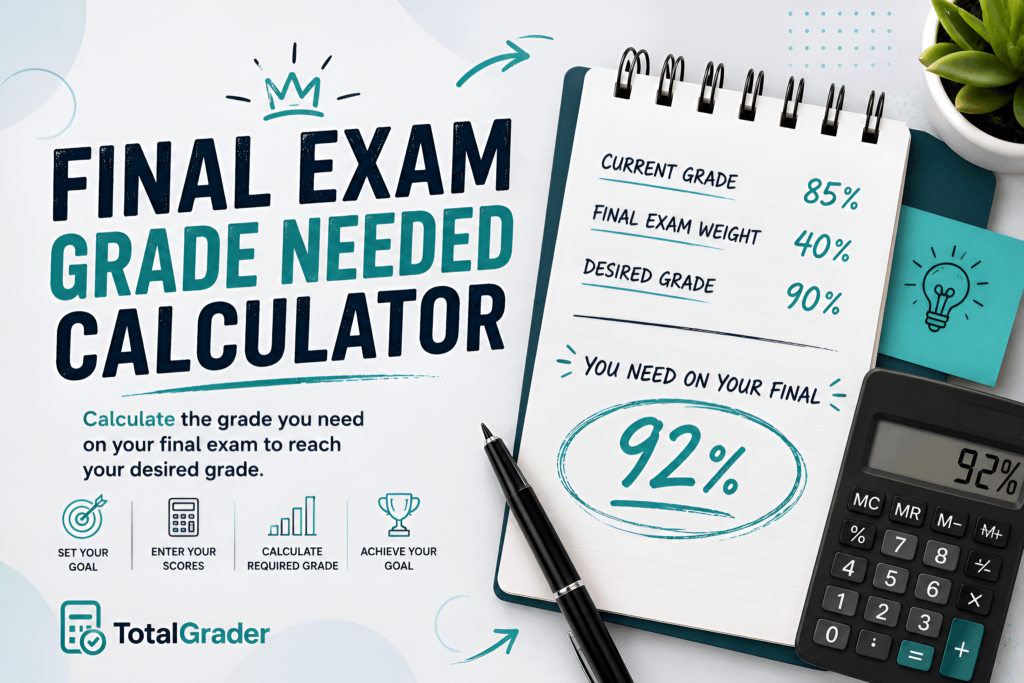
Final Exam Grade Needed Calculator
Wondering what grade you need on your final exam to reach your desired course grade? A Final Exam Grade Needed Calculator can give you a quick answer using three important numbers: your current grade, the percentage your final exam is worth, and the overall grade you want to achieve.
Instead of manually working through a weighted-grade formula, you can enter your numbers into the calculator and instantly see the final exam score needed to reach your target.
This guide explains how the calculation works, how to use a Final Exam Grade Needed Calculator correctly, what happens when your required score is above 100%, and how different final-exam weights can affect your result.
Final Exam Grade Needed Calculator
Use the calculator above to determine the minimum score you need on your final exam.
Typically, you need to enter:
- Current grade: Your percentage before taking the final exam.
- Final exam weight: How much the final counts toward your overall course grade.
- Target grade: The overall percentage you want after the final.
The calculator then determines the exam score required to reach your target.
For example, if you currently have an 85%, your final exam is worth 30%, and you want to finish the course with a 90%, the calculation tells you how high your final exam score needs to be.
What Is a Final Exam Grade Needed Calculator?
A Final Exam Grade Needed Calculator is an educational tool that determines the exam score required to achieve a specific overall course grade.
The calculation is based on a weighted-average system. Your current grade represents the portion of the course you have already completed, while your final exam contributes the remaining percentage.
For example, suppose:
- Current grade = 85%
- Final exam weight = 30%
- Target course grade = 90%
Your current coursework represents the remaining 70% of the course, while the final exam represents 30%.
The calculator combines these weighted values to determine the score you need on the final.
This type of calculation is commonly used when students are preparing for final exams and want to know whether a particular target grade is still achievable.
How Does the Final Exam Grade Needed Calculator Work?
The calculator uses a weighted-grade equation.
The basic course-grade equation is:
Overall Grade = Current Grade × (1 − Final Exam Weight) + Final Exam Score × Final Exam Weight
To find the final exam score instead, the equation can be rearranged:
Final Exam Score Needed = (Target Grade − Current Grade × (1 − Final Exam Weight)) ÷ Final Exam Weight
The final exam weight must be converted from a percentage into a decimal.
For example:
- 10% = 0.10
- 20% = 0.20
- 25% = 0.25
- 30% = 0.30
- 40% = 0.40
- 50% = 0.50
This is the standard weighted-average approach used by final-grade calculators.
Final Exam Grade Needed Formula
The formula is:
Required Final Exam Score = (Target Grade − Current Grade × (1 − Final Weight)) ÷ Final Weight
Where:
- Current Grade = your current course percentage
- Target Grade = the overall course percentage you want
- Final Weight = the final exam’s percentage expressed as a decimal
- Required Final Exam Score = the score you need on the final
Example
Suppose you have:
- Current grade: 85%
- Target grade: 90%
- Final exam weight: 30%
First convert 30% to 0.30.
Then:
Required Score = (90 − 85 × (1 − 0.30)) ÷ 0.30
Required Score = (90 − 85 × 0.70) ÷ 0.30
Required Score = (90 − 59.5) ÷ 0.30
Required Score = 30.5 ÷ 0.30
Required Score = 101.67%
In this example, you would need approximately 101.67% on the final to finish with a 90%.
Because a standard exam normally has a maximum score of 100%, a 90% final course target would not be achievable without extra credit or another change to the grading calculation.

How to Use the Final Exam Grade Needed Calculator
Using a Final Exam Grade Needed Calculator is straightforward.
Step 1: Enter Your Current Grade
Enter your current percentage before the final exam.
For example:
Current grade = 82%
Make sure you use the grade that actually represents the work included in your course grade.
Step 2: Enter the Final Exam Weight
Enter how much the final exam contributes to your overall course grade.
For example:
Final exam weight = 25%
If your syllabus says the final is worth 25% of your course grade, enter 25%.
Step 3: Enter Your Target Grade
Enter the overall course grade you want after completing the final.
For example:
Target grade = 90%
Step 4: Calculate the Required Score
The calculator applies the weighted-grade formula and returns the score you need to earn on your final exam.
This lets you quickly determine whether your target is realistic and how much you need to score.
Final Exam Grade Needed Examples
Understanding several examples can make the calculation easier.
Example 1: Current Grade 80%, Final Worth 20%, Target 85%
Suppose:
- Current grade = 80%
- Final exam = 20%
- Target grade = 85%
Formula:
(85 − 80 × 0.80) ÷ 0.20
= (85 − 64) ÷ 0.20
= 21 ÷ 0.20
= 105%
You would need 105%, so the target is not achievable through the final alone under this grading system.
Example 2: Current Grade 85%, Final Worth 40%, Target 90%
Suppose:
- Current grade = 85%
- Final exam = 40%
- Target = 90%
Calculation:
(90 − 85 × 0.60) ÷ 0.40
= (90 − 51) ÷ 0.40
= 39 ÷ 0.40
= 97.5%
You need approximately 97.5% on the final to finish with a 90%.
Example 3: Current Grade 90%, Final Worth 25%, Target 85%
Now suppose you already have a strong grade:
- Current grade = 90%
- Final exam = 25%
- Target = 85%
Calculation:
(85 − 90 × 0.75) ÷ 0.25
= (85 − 67.5) ÷ 0.25
= 17.5 ÷ 0.25
= 70%
You need 70% on the final to finish with an 85%.
Example 4: Current Grade 75%, Final Worth 50%, Target 80%
Suppose:
- Current grade = 75%
- Final exam = 50%
- Target = 80%
Calculation:
(80 − 75 × 0.50) ÷ 0.50
= (80 − 37.5) ÷ 0.50
= 42.5 ÷ 0.50
= 85%
You need 85% on the final to finish the course with an 80%.
What If the Required Final Exam Score Is Above 100%?
If the calculator says you need more than 100%, your target grade is mathematically impossible to reach through the final exam alone under the assumptions being used.
For example, if the calculator says:
Required final score = 104%
A normal exam cannot provide a score above 100%.
This does not necessarily mean your gradebook is wrong. It means that your current grade, final-exam weight, and target grade do not leave enough available points to reach your target.
You may want to:
- Check your current grade.
- Confirm the final exam weight.
- Check whether extra credit is available.
- Review whether your teacher drops a low assignment.
- Check whether additional coursework remains.
- Consider setting a more realistic target.
A result above 100% is an important warning rather than a normal exam target.
What If the Required Score Is 0% or Negative?
A required score of 0% or less usually means you have already secured your target under the calculator’s assumptions.
For example, imagine:
- Current grade = 95%
- Final exam weight = 20%
- Target = 75%
Your current performance may already be high enough that even a very low final score would leave your overall grade at or above 75%.
However, you should still check your school’s rules. Some courses require students to take the final exam even when the target grade is mathematically secured.
How Much Does the Final Exam Weight Matter?
The final exam’s weight can make a major difference.
A final worth 10% of your course has much less influence on your overall grade than a final worth 50%.
For example, if your current grade is 85% and you want to finish with 90%, a small final weight may make the target extremely difficult or impossible. A larger final weight gives the exam more influence over the final course grade.
This is because the final exam only controls the portion of your overall grade assigned to it.
Why Final Weight Matters
Consider two courses where your current grade is 85% and your target is 90%.
If the final is worth 20%, you need a very high score because most of your final course grade is already determined by the 85% current average.
If the final is worth 50%, the exam has much more influence, so you may have a better mathematical opportunity to increase your overall grade.
What Is the Highest Grade You Can Get on the Final?
You can calculate your highest possible course grade by assuming you score 100% on the final.
Use:
Maximum Course Grade = Current Grade × (1 − Final Weight) + 100 × Final Weight
Example
Suppose:
- Current grade = 78%
- Final weight = 30%
Then:
Maximum Grade = 78 × 0.70 + 100 × 0.30
= 54.6 + 30
= 84.6%
So even with a perfect score on the final, your highest possible overall grade would be 84.6%.
This is useful when deciding whether a target grade is still possible.
What Is the Lowest Grade You Can Finish With?
You can also calculate the lowest possible final course grade by assuming you receive 0% on the final.
The formula is:
Minimum Course Grade = Current Grade × (1 − Final Weight)
For example, if your current grade is 85% and your final is worth 30%:
85 × 0.70 = 59.5%
Your final course grade would be 59.5% if you scored 0% on the final, assuming the calculator’s simple weighted-average model applies.
Knowing both your highest and lowest possible results can help you understand how much the final exam can change your grade.
How to Calculate Your Final Course Grade If You Know Your Exam Score
You may also want to know what your overall grade will be after the final.
In that case, use:
Final Course Grade = Current Grade × (1 − Final Weight) + Final Exam Score × Final Weight
Example
Suppose:
- Current grade = 88%
- Final exam score = 92%
- Final exam weight = 25%
Calculation:
88 × 0.75 + 92 × 0.25
= 66 + 23
= 89%
Your final course grade would be 89%.
A calculator can therefore work in both directions: you can find the score you need, or you can estimate your final course grade based on an expected exam score.
Final Exam Grade Needed for Common Targets
Your required score depends entirely on your current grade and final exam weight. There is no single final-exam score that applies to every student.
For example, a student with a 90% current grade may need a relatively modest final score to maintain a B or A, while a student with a 70% current grade may need an exceptionally high final score to reach the same target.
The best approach is to enter your own numbers rather than relying on a generic grade chart.
Common Mistakes When Calculating the Grade You Need
1. Entering the Final Weight Incorrectly
One of the most common mistakes is treating 30% as 30 instead of 0.30 inside the mathematical formula.
For example:
30% = 0.30
The calculator handles this conversion automatically if the input asks for the percentage.
2. Using Your Target Grade as Your Current Grade
Your current grade and target grade are different values.
For example:
- Current grade = 82%
- Target grade = 90%
Do not enter 90% as your current grade.
3. Forgetting the Final Exam Weight
The final’s percentage determines how much influence the exam has over your overall grade.
Always check your syllabus or official gradebook before entering the weight.
4. Assuming Every Course Uses the Same Formula
Not every grading system works exactly the same way.
Some courses may include:
- Dropped assignments
- Extra credit
- Grade curves
- Category weighting
- Multiple final assessments
- Attendance requirements
- Separate project requirements
- Minimum-exam requirements
If your course uses one of these systems, the simple final-exam calculator may not exactly match your instructor’s gradebook.
5. Rounding Too Early
Rounding your current grade before calculating can slightly change the result.
If your gradebook gives you a value such as 87.43%, use that value when possible instead of immediately rounding it to 87%.
Can I Use a Final Exam Grade Needed Calculator for College?
Yes. A Final Exam Grade Needed Calculator can be useful for college courses when the grading system uses a straightforward weighted-average structure.
You can use it to estimate:
- The score needed to pass.
- The score needed for a B.
- The score needed for an A.
- The score needed to maintain your current grade.
- The maximum possible final course grade.
- Whether a target is mathematically achievable.
However, always compare the calculation with your college syllabus and official gradebook because individual courses can use different grading rules.
Can I Use It for High School Classes?
Yes. The same weighted-grade principle can be used for many high school classes if the final exam is assigned a specific percentage of the course grade.
For example, if your final exam accounts for 20% of your course grade, you can enter 20% as the final exam weight.
If your teacher instead calculates grades using separate categories such as tests, homework, projects, and quizzes, you may need a weighted grade calculator that handles each category separately.
What If My Class Has Homework, Quizzes, Midterms, and a Final?
A simple Final Exam Grade Needed Calculator works best when your grade before the final is already known.
For example, if your gradebook says your current course average is 84%, you can use 84% as your current grade.
However, if you need to calculate your current grade from individual categories first, you may need a Weighted Grade Calculator.
For example:
- Homework = 20%
- Quizzes = 15%
- Midterm = 25%
- Projects = 10%
- Final exam = 30%
In that situation, each category contributes separately to the overall grade. A category-based calculator may provide a more accurate result than simply entering individual assignment scores into the basic final-exam formula.
What If My Final Exam Is Worth 100%?
If the final exam represents 100% of your course grade, your final exam score becomes your overall grade.
For example:
- Final exam weight = 100%
- Target grade = 90%
You would need 90% on the final.
This is a special case because none of your previous coursework contributes to the final grade under that grading structure.

How to Set a Realistic Final Exam Goal
Knowing the score you need is useful, but it is only the first step.
If the calculator tells you that you need 95% on your final, you can turn that number into a study target.
1. Identify Your Required Score
Start with the exact result from the calculator.
For example:
Required score = 92%
2. Set a Small Safety Margin
Instead of planning to score exactly 92%, you may choose to aim slightly higher.
For example:
Study target = 95%
This gives you some room for mistakes.
3. Focus on High-Value Topics
Review topics that are most likely to appear on the exam and areas where you have previously lost points.
4. Practice Under Exam Conditions
Try completing practice questions within a time limit. This can help identify whether your challenge is understanding the material, remembering information, or managing time.
5. Recalculate If Your Grade Changes
If another assignment is added before the final, your current grade may change. Update the calculator with your new grade rather than continuing to use an old number.
Why Use a Final Exam Grade Needed Calculator?
A calculator can save time and reduce arithmetic mistakes.
Instead of repeatedly solving a weighted-average equation, you can enter your information and immediately see the required score.
It can also help answer practical questions such as:
- What do I need to pass?
- What do I need to get an A?
- Can I still get an A?
- What is the highest grade I can finish with?
- What happens if I score 80% on the final?
- How much does the final exam affect my overall grade?
The most useful calculators also make it clear when a target is impossible or already secured.
Important: Check Your School’s Grading Rules
A calculator provides a mathematical estimate based on the information you enter. Your instructor’s official grading policy takes priority.
Before relying on the result, verify:
- Your current grade.
- The final exam percentage.
- Whether your current grade includes all completed work.
- Whether missing assignments count as zero.
- Whether your instructor drops the lowest score.
- Whether extra credit is available.
- Whether the course uses a grading curve.
- Whether there are separate requirements for passing.
If your course has unusual rules, the basic calculation may not match your final transcript grade.
Final Exam Grade Needed Calculator vs. Final Grade Calculator
These terms are closely related, but they can describe slightly different purposes.
A Final Exam Grade Needed Calculator usually answers:
“What score do I need on my final exam to reach my target grade?”
A Final Grade Calculator can also answer:
“What will my final course grade be if I receive a particular score on the final?”
For example, if you have an 85% current grade and expect to score 90% on a final worth 30%, a final-grade calculator can estimate your resulting overall grade.
Both calculations use the same weighted-average concept.
Frequently Asked Questions
What score do I need on my final exam to get an A?
Enter your current grade, the percentage your final exam is worth, and the percentage required for an A in your course. The calculator will determine the required final exam score.
Remember that A-grade thresholds vary by school, course, and grading scale, so use the threshold specified by your institution.
How do I calculate what I need on my final?
Use:
Required Final Score = (Target − Current × (1 − Final Weight)) ÷ Final Weight
Convert the final exam percentage into a decimal before applying the formula.
What if I need more than 100% on my final?
A result above 100% means your target is mathematically unreachable through the final alone under the assumptions used by the calculator. Check for extra credit, additional assignments, dropped scores, or other grading rules.
What if the calculator says I need 0%?
A required score of 0% generally means your target is already secured mathematically. You should still follow your school’s rules about taking the final.
Does the calculator work for college students?
Yes. It can work for college courses that use a straightforward weighted-average grading system.
Does it work for high school?
Yes. If your final exam has a defined percentage of the overall course grade, you can use that percentage in the calculation.
What if my final is worth 20%?
Enter 20% as the final exam weight. The calculator will treat the remaining 80% as your current coursework.
What if my final is worth 30%?
Enter 30%. The remaining 70% represents the portion of your course grade covered by your current grade.
Can I calculate the highest grade I can get?
Yes. Assume you score 100% on the final:
Maximum Course Grade = Current × (1 − Final Weight) + 100 × Final Weight
This tells you the highest overall grade you can achieve under the basic weighted-average model.
Can I calculate the lowest grade I can get?
Yes. Assume you score 0%:
Minimum Course Grade = Current × (1 − Final Weight)
This estimates the lowest overall grade possible if the final is the only remaining graded component.
Is the result always exact?
The mathematical result is exact for the assumptions entered, but your school’s actual grade may differ if the course uses additional grading rules such as curves, extra credit, dropped assignments, or category-specific weighting.
Final Exam Grade Needed Calculator: Quick Summary
A Final Exam Grade Needed Calculator helps you determine the exam score required to reach a specific overall course grade.
You generally need three pieces of information:
- Your current grade
- Your final exam weight
- Your target overall grade
The main formula is:
Required Final Exam Score = (Target Grade − Current Grade × (1 − Final Weight)) ÷ Final Weight
The result can help you determine whether your target is achievable and how high you need to score.
If the result is above 100%, your target is not achievable through the final alone under the basic grading model. If the result is 0% or lower, your target may already be secured.
For the most accurate result, always compare your calculator inputs with your official gradebook and course syllabus.
Final Exam Grade Needed Calculator: Plan Smarter for Your Final
Instead of guessing how much you need to score, use the Final Exam Grade Needed Calculator to understand exactly where you stand. Once you know your required score, you can set a realistic study goal, prioritize weak areas, and prepare for the final with a clearer target.