
Letter Grade to Percentage Calculator
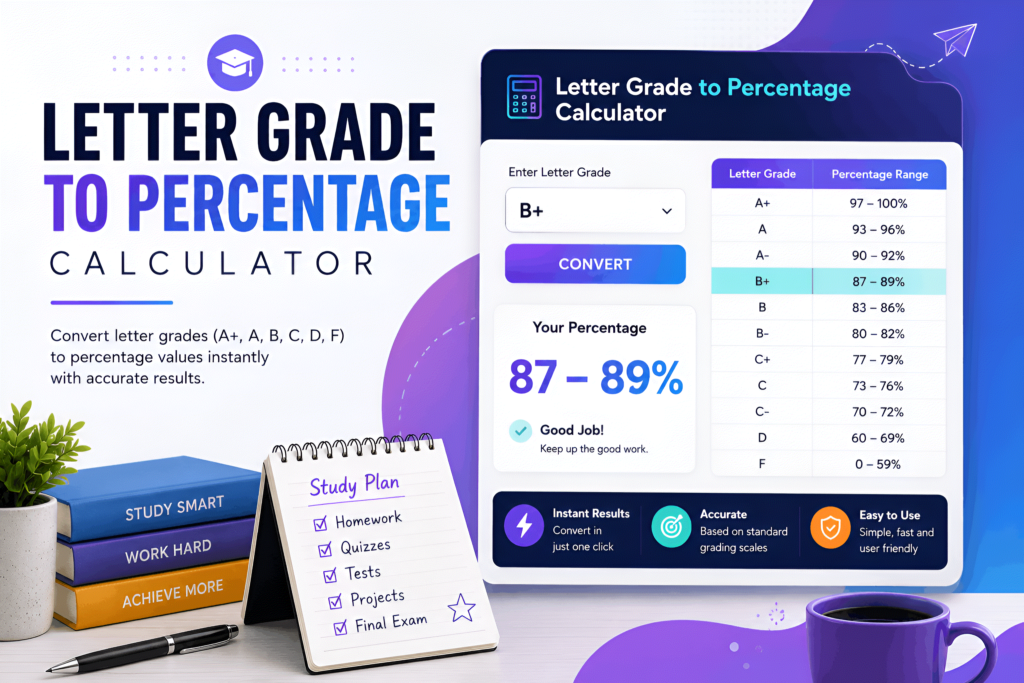
A Letter Grade to Percentage Calculator helps students quickly understand the percentage range associated with a letter grade such as A, B, C, D, or F. Instead of manually checking a grading chart, you can select a letter grade and see its estimated percentage range immediately.
Letter grades do not have one universal percentage equivalent. Schools, colleges, teachers, universities, and countries can use different grading systems. For example, one institution may consider an A to begin at 90%, while another may use 93% as the minimum for an A. Plus and minus grades can also change the range.
This calculator is therefore most useful as a quick reference tool. If you need an official percentage conversion for admission, transfer credit, scholarships, employment, or academic records, always check the grading policy provided by your school or institution.
What Is a Letter Grade to Percentage Calculator?
A Letter Grade to Percentage Calculator converts a letter grade into its corresponding percentage range according to a selected grading scale.
For example, under a common U.S. plus/minus grading scale:
- A+ = 97–100%
- A = 93–96%
- A- = 90–92%
- B+ = 87–89%
- B = 83–86%
- B- = 80–82%
- C+ = 77–79%
- C = 73–76%
- C- = 70–72%
- D+ = 67–69%
- D = 63–66%
- D- = 60–62%
- F = below 60%
These ranges are commonly used as a reference, but they are not universal. Some institutions use a simpler scale such as A = 90–100%, B = 80–89%, C = 70–79%, D = 60–69%, and F below 60%.

How Does the Letter Grade to Percentage Calculator Work?
The calculator works by matching your selected letter grade with the percentage range assigned to that grade on a particular grading scale.
For example, suppose you select B+ on a standard plus/minus scale. The calculator identifies the B+ range as 87% to 89%.
This does not mean that every student who receives a B+ earned exactly 88%. It means the student’s percentage falls somewhere within the applicable range.
The same process works for other grades. If you select A-, the calculator can display 90–92%, while selecting C can display 73–76% under the same scale.
Because grading policies differ, the calculator should display the grading scale it is using rather than presenting one conversion as universally official.
Letter Grade to Percentage Conversion Chart
The following table shows a common U.S. plus/minus grading scale.
| Letter Grade | Percentage Range | GPA Points |
|---|---|---|
| A+ | 97–100% | 4.0 |
| A | 93–96% | 4.0 |
| A- | 90–92% | 3.7 |
| B+ | 87–89% | 3.3 |
| B | 83–86% | 3.0 |
| B- | 80–82% | 2.7 |
| C+ | 77–79% | 2.3 |
| C | 73–76% | 2.0 |
| C- | 70–72% | 1.7 |
| D+ | 67–69% | 1.3 |
| D | 63–66% | 1.0 |
| D- | 60–62% | 0.7 |
| F | Below 60% | 0.0 |
The GPA values shown above are commonly associated with this type of 4.0-scale reference, but institutions may assign different GPA values, particularly for A+ grades.
Simple Letter Grade to Percentage Chart
Some schools do not use plus and minus grades. Instead, they use a straightforward grading scale.
| Letter Grade | Percentage Range |
|---|---|
| A | 90–100% |
| B | 80–89% |
| C | 70–79% |
| D | 60–69% |
| F | Below 60% |
This simpler system is widely used as a general reference, but your actual class may have different cutoffs.
How to Convert a Letter Grade to Percentage
Converting a letter grade to a percentage is different from converting marks directly into a percentage.
A letter grade normally represents a range, not one exact number.
For example, if your grade is B+ under a scale where B+ represents 87–89%, your estimated percentage range is 87% to 89%.
If you need one number instead of a range, some applications may use the midpoint as an estimate. For an 87–89% range:
Midpoint = (87 + 89) ÷ 2
Midpoint = 88%
However, 88% should be treated as an estimate rather than your official percentage unless your institution specifically defines the conversion that way.
Example: A Grade to Percentage
Suppose you received an A.
Under a common plus/minus scale, an A may correspond to:
93%–96%
Therefore:
A = approximately 93% to 96%
If you need an exact percentage for an application, do not automatically enter 94.5% or another midpoint. Check your institution’s official grading records or conversion policy.
Example: B Grade to Percentage
Suppose your transcript shows a B.
Under the common plus/minus scale:
B = 83%–86%
A B therefore represents a percentage somewhere within that range.
For example, an 83% and an 86% can both produce a B under this scale even though the numerical scores are different.
Example: C Grade to Percentage
Under the same grading system:
C = 73%–76%
If your letter grade is C, the calculator can show this percentage range as a quick reference.
The exact underlying score depends on your institution’s grading rules and whether your teacher uses rounding, weighting, curves, or other grading policies.
Example: D Grade to Percentage
A D on the common plus/minus scale can represent:
D = 63%–66%
The exact cutoff may differ at your school. Some grading systems use D for a broader 60–69% range without plus and minus distinctions.
Example: F Grade to Percentage
On the common U.S. scale, an F is generally associated with a score below 60%.
However, failing thresholds vary between institutions. Some schools, programs, or countries use different minimum passing percentages.
For that reason, an F should not automatically be assumed to mean exactly the same percentage everywhere.
Letter Grade to Percentage vs. Percentage to Letter Grade
These two calculations work in opposite directions.
Letter Grade to Percentage
You start with a letter and determine its percentage range.
Example:
B+ → 87–89%
Percentage to Letter Grade
You start with a percentage and determine the corresponding letter.
Example:
88% → B+
The second calculation is usually more precise because you already have the numerical score and only need to identify which grading band contains it.
How to Calculate Percentage From Marks
If you have the actual number of marks earned, you can calculate your percentage directly.
Use this formula:
Percentage = (Marks Earned ÷ Total Marks) × 100
For example, imagine you scored 46 marks out of 50.
Percentage = (46 ÷ 50) × 100
Percentage = 92%
Under a common plus/minus scale, 92% falls within the A- range.
This method gives you an actual percentage instead of an estimated range from a letter grade.
Why a Letter Grade Does Not Always Give an Exact Percentage
A letter grade usually covers several percentage points.
For example, if B+ represents 87–89%, the letter grade alone does not tell you whether the student earned 87%, 88%, or 89%.
This is one of the most important limitations of grade conversion.
A transcript that only reports B+ may not contain enough information to determine the original numerical percentage. If an exact percentage is required, the institution may need to provide an official conversion or the original numerical score.
Do All Schools Use the Same Grading Scale?
No. Grading scales can differ significantly.
One school may use:
- A = 90–100%
- B = 80–89%
- C = 70–79%
- D = 60–69%
- F = below 60%
Another institution may use plus and minus grades, such as A-, B+, and C-. Some schools may also use custom cutoffs.
Certain countries and education systems use completely different grading structures. For example, a grading system used by a U.S. school should not automatically be applied to a Pakistani board, British qualification, or another international education system.
Therefore, always select the correct grading scale when one is available.
Standard Grading Scale vs. Plus/Minus Scale
A standard grading scale groups several percentages into one letter.
For example:
- 90–100% = A
- 80–89% = B
- 70–79% = C
- 60–69% = D
- Below 60% = F
A plus/minus scale divides these categories into smaller bands.
For example:
- 90–92% = A-
- 93–96% = A
- 97–100% = A+
This provides more detail about where a student’s score falls within a broad letter category.
Can You Convert a Letter Grade Into GPA?
A letter grade can often be associated with a GPA value, but the exact GPA conversion depends on the institution.
For example, a common 4.0 reference may associate:
- A+ = 4.0
- A = 4.0
- A- = 3.7
- B+ = 3.3
- B = 3.0
- B- = 2.7
- C+ = 2.3
- C = 2.0
- C- = 1.7
- D+ = 1.3
- D = 1.0
- D- = 0.7
- F = 0.0
Some institutions treat A+ differently, so these values should not be treated as a universal GPA policy.
Why Use a Letter Grade to Percentage Calculator?
A calculator can make grade conversion faster and easier.
Quick Reference
Instead of searching through several grading tables, you can enter or select your letter grade and view the relevant percentage range.
Reduces Manual Errors
Manually checking multiple grading bands can lead to mistakes. An automated calculator can immediately display the range associated with the selected grade.
Useful for Students
Students can use the calculator to understand what their letter grades generally represent before reviewing their academic records.
Helpful for Teachers
Teachers can use a grade conversion tool as a quick reference when explaining grading scales to students.
Useful for Academic Planning
Understanding percentage ranges can help students identify the score bands associated with different letter grades.
Important: Check Your School’s Grading Policy
A calculator provides a conversion based on the grading scale programmed into it. It does not override your school’s official policy.
Your institution may use:
- Different percentage cutoffs
- A custom grading scale
- Plus and minus grades
- Weighted assignments
- Rounding rules
- Grade curves
- Different GPA calculations
- Course-specific requirements
For an official application, transcript evaluation, scholarship, transfer, or admissions process, use the conversion rules provided by the relevant institution.
Letter Grade to Percentage for College Applications
Students sometimes want to convert a transcript grade into a percentage for an application.
This should be handled carefully.
If your transcript reports a letter grade but does not provide an exact percentage, you should not automatically invent an exact percentage using the midpoint of the grade range.
For example, if B+ represents 87–89%, selecting 88% as an estimated midpoint does not prove that your original score was 88%.
If an application specifically requires a percentage, check its instructions to determine whether it accepts an estimated conversion, requires an official institutional conversion, or expects the original grading system.

Letter Grade to Percentage for Scholarships
Scholarship providers may have their own eligibility requirements.
A scholarship might require a minimum GPA, percentage, class rank, or specific academic average. Because conversion rules differ, use the scholarship provider’s stated requirements rather than assuming that every letter grade has one universally accepted percentage equivalent.
If the scholarship requires official documentation, an institutional transcript or conversion statement may be more appropriate than a general online calculator.
Letter Grade to Percentage for International Students
International students should be particularly careful when converting grades.
Educational systems vary between countries, and a letter grade in one country may not have the same meaning as a letter grade in another.
For example, a U.S. grading scale should not automatically be applied to another country’s examination system.
When applying to an international university, follow the institution’s published international grading requirements. If an official credential evaluation is required, use the evaluator specified by the institution.
Common Mistakes When Converting Letter Grades
Assuming Every A Equals 90%
Some grading systems define A as 90–100%, while others may define A as 93–96% with A+ and A- included.
Treating a Grade Range as an Exact Score
A B+ may represent several possible percentages. The letter alone may not reveal the exact numerical score.
Ignoring Plus and Minus Grades
B and B+ are not necessarily the same under a plus/minus grading system.
Using the Wrong Country’s Scale
Different education systems can use different grading structures. Always verify which system applies.
Confusing Percentage With GPA
A percentage and GPA are different measurements. A 90% score should not automatically be interpreted as a 4.0 GPA without checking the applicable conversion system.
Using an Online Estimate as an Official Conversion
Online calculators are useful for reference, but an institution’s official grading policy takes precedence.
Frequently Asked Questions
What is a Letter Grade to Percentage Calculator?
A Letter Grade to Percentage Calculator converts a letter grade such as A, B+, C, or D into the percentage range associated with that grade under a selected grading scale.
What percentage is an A?
It depends on the grading scale. On a common simple U.S. scale, an A represents 90–100%. On a common plus/minus scale, A may represent 93–96%, while A- represents 90–92% and A+ represents 97–100%.
What percentage is a B?
On a simple 10-point scale, B commonly represents 80–89%. On a plus/minus scale, B is commonly 83–86%, while B+ is 87–89% and B- is 80–82%.
What percentage is a C?
On a simple grading scale, C commonly represents 70–79%. On a plus/minus scale, C is commonly 73–76%, while C+ is 77–79% and C- is 70–72%.
Can I convert a letter grade to one exact percentage?
Not always. A letter grade usually represents a range of percentages. If the original numerical score is unavailable, an exact percentage may not be recoverable from the letter grade alone.
Is A+ always worth 4.0 GPA?
No. GPA policies vary by institution. A common 4.0 reference assigns A+ a value of 4.0, but some schools use different calculations.
Is 90% always an A?
No. It depends on the grading system. Under a simple 90–100% scale, 90% is an A. Under a plus/minus scale, 90% can be an A-.
Can I use this calculator for any school?
You can use a general calculator for reference, but you should verify your school’s grading scale first. If your institution uses custom cutoffs, a standard conversion may produce a different result.
How do I convert marks into a percentage?
Divide the marks earned by the total possible marks and multiply by 100.
Percentage = (Marks Earned ÷ Total Marks) × 100
For example, 45 out of 50 equals 90%.
What is the difference between a percentage and a letter grade?
A percentage is a numerical score, such as 85%. A letter grade converts that score into a category, such as B, according to a grading scale.
Final Thoughts
A Letter Grade to Percentage Calculator is a convenient way to understand the percentage range associated with an academic letter grade. It can quickly show what A, B, C, D, and plus/minus grades generally represent.
However, there is no single grading scale that applies to every school, college, country, or course. The same letter grade can represent different percentage ranges depending on the institution.
For everyday reference, a standard conversion chart is useful. For official academic, admissions, scholarship, or employment purposes, always use the grading policy provided by the relevant institution.
If you know your actual marks, calculating the percentage directly is generally more informative because it gives you the numerical score rather than only a grade range.