
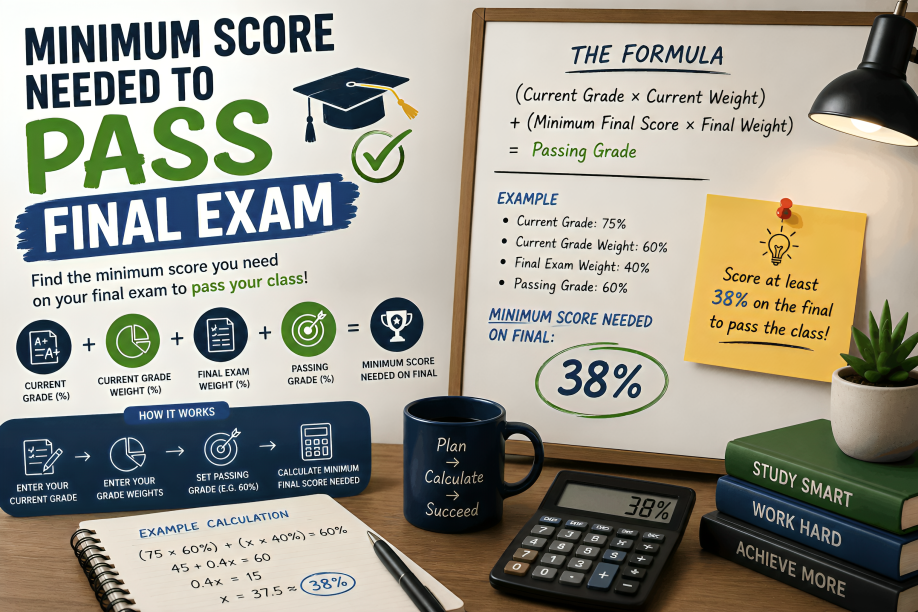
Minimum Score Needed to Pass Final Exam
Wondering about the minimum score needed to pass final exam requirements? The answer depends on your current course grade, the percentage your final exam contributes to the overall grade, and the minimum passing grade set by your school or instructor.
You do not always need a high score on the final exam to pass. If you have already earned enough points throughout the semester, a relatively low final-exam score may be enough. On the other hand, if your current grade is low or the final carries a large percentage of the course grade, you may need a much higher score.
The calculation is based on a weighted-grade formula. By entering your current grade, final exam weight, and required passing grade, you can determine the minimum percentage you need to earn on the final.
What Is the Minimum Score Needed to Pass a Final Exam?
The minimum score needed to pass a final exam is the lowest score you can earn on the final while still finishing the course with the required overall passing grade.
For example, suppose:
- Your current grade is 72%
- Your final exam is worth 30%
- Your school requires 60% overall to pass
Your current grade represents the other 70% of the course. The final exam represents the remaining 30%.
The required score can be calculated using:
Required Final Exam Score = [Passing Grade − (Current Grade × (1 − Final Exam Weight))] ÷ Final Exam Weight
The final-exam weight must be written as a decimal. Therefore, a 30% final becomes 0.30.
In this example:
Required Score = [60 − (72 × 0.70)] ÷ 0.30
Required Score = (60 − 50.4) ÷ 0.30
Required Score = 32%
Therefore, you would need approximately 32% on the final exam to finish the course with a 60% overall grade.
The exact calculation depends on how your school calculates grades. Some institutions use weighted percentages, while others calculate grades directly from points earned.
How to Calculate the Minimum Final Exam Score
Calculating the required final exam score involves three important numbers:
- Your current grade
- The final exam weight
- The minimum overall grade required to pass
Once you have these values, you can work backward from the passing requirement.
Step 1: Find Your Current Grade
Start by checking your current course grade before the final exam.
For example:
Current grade = 75%
Make sure this percentage represents the coursework completed before the final. If your school’s gradebook already includes a predicted or placeholder final-exam score, the number may need to be adjusted.

Step 2: Find the Final Exam Weight
Check your syllabus, course outline, or gradebook to determine how much the final contributes to your total course grade.
For example:
Final exam weight = 40%
Convert this percentage into decimal form:
40% = 0.40
The remaining coursework therefore represents:
100% − 40% = 60%
Step 3: Identify the Passing Grade
The passing threshold is determined by your school, course, instructor, program, or examination system.
For example:
Required overall grade = 50%
Do not automatically assume that one passing percentage applies everywhere. Passing requirements can differ by institution, course, qualification, and grading system.
Step 4: Apply the Formula
Use:
Required Final Score = [Target Grade − (Current Grade × (1 − Final Weight))] ÷ Final Weight
Suppose your current grade is 75%, your final is worth 40%, and you need 50% overall.
Required Score = [50 − (75 × 0.60)] ÷ 0.40
Required Score = [50 − 45] ÷ 0.40
Required Score = 12.5%
You would need at least 12.5% on the final exam to reach a 50% overall course grade under this grading model.
Minimum Score Needed to Pass Final Exam Formula
The standard formula is:
Minimum Final Exam Score = [Passing Grade − (Current Grade × (1 − Final Exam Weight))] ÷ Final Exam Weight
Where:
- Passing Grade = minimum overall percentage required to pass
- Current Grade = your average before the final
- Final Exam Weight = final exam’s percentage of the total course grade
- Minimum Final Exam Score = score required on the final
For example, if your current grade is 80%, the final is worth 25%, and you need 60% overall:
Required Score = [60 − (80 × 0.75)] ÷ 0.25
Required Score = [60 − 60] ÷ 0.25
Required Score = 0%
In this situation, a 0% final would mathematically leave you at 60% overall, assuming the stated grading rules apply.
The same formula can be used for a target grade higher than the minimum passing mark.
Minimum Score Needed to Pass Final Exam: Examples
Understanding several examples makes the calculation easier.
Example 1: Current Grade Is 80%
Suppose:
- Current grade = 80%
- Final exam weight = 30%
- Passing grade = 60%
The coursework portion contributes:
80 × 0.70 = 56
You need 60 points overall, so the final must contribute:
60 − 56 = 4
Because the final is worth 30%:
4 ÷ 0.30 = 13.33%
You need approximately 13.33% on the final to reach 60% overall.
Example 2: Current Grade Is 65%
Suppose:
- Current grade = 65%
- Final exam weight = 40%
- Passing grade = 60%
Calculation:
Required Score = [60 − (65 × 0.60)] ÷ 0.40
= [60 − 39] ÷ 0.40
= 52.5%
You need 52.5% on the final.
Example 3: Current Grade Is 55%
Suppose:
- Current grade = 55%
- Final exam weight = 40%
- Passing grade = 60%
Calculation:
Required Score = [60 − (55 × 0.60)] ÷ 0.40
= [60 − 33] ÷ 0.40
= 67.5%
You need 67.5% on the final to finish with a 60% overall grade.
Example 4: Current Grade Is 45%
Suppose:
- Current grade = 45%
- Final exam weight = 50%
- Passing grade = 60%
Calculation:
Required Score = [60 − (45 × 0.50)] ÷ 0.50
= [60 − 22.5] ÷ 0.50
= 75%
You would need 75% on the final exam.
These examples demonstrate why the same final-exam weight can produce very different required scores depending on your current grade.
What If You Need More Than 100% to Pass?
Sometimes the calculation produces a result above 100%.
For example:
- Current grade = 40%
- Final exam weight = 30%
- Passing grade = 60%
The calculation is:
Required Score = [60 − (40 × 0.70)] ÷ 0.30
= [60 − 28] ÷ 0.30
= 106.67%
A score of 106.67% is higher than the normal maximum of 100%. This means the 60% overall target is not mathematically achievable through the final exam alone, assuming there are no additional points, extra credit, grade replacements, or other grading adjustments.
If your calculation produces a result above 100%, check your syllabus and speak with your instructor about the grading rules rather than assuming you have no options.
A required score above 100% is a mathematical signal that the target cannot be reached under the assumptions used in the calculation.
What If You Need 0% or Less to Pass?
The opposite situation can also occur.
Suppose your current grade is already high enough that even a zero on the final would leave you at or above the passing threshold.
For example:
- Current grade = 85%
- Final exam weight = 20%
- Passing grade = 60%
The coursework contributes:
85 × 0.80 = 68%
Because 68% is already above the 60% passing requirement, the mathematical minimum final score is below zero.
Since a normal exam score cannot be negative, the practical minimum is 0%, assuming the final is simply weighted into the overall grade and there is no separate final-exam passing requirement.
Some courses, however, require students to pass the final examination separately. Always check the specific course rules.

Does the Final Exam Have to Be Passed Separately?
Not necessarily.
Some courses determine passing status entirely from the overall course grade. In that situation, your final score is simply another weighted component.
Other courses may establish a separate minimum final-exam requirement. For example, a syllabus could require students to earn a certain percentage on the final regardless of their overall course average.
This distinction is important because an overall-grade calculation alone may not capture every academic requirement.
Before relying on a calculated minimum score, check:
- Course syllabus
- Examination rules
- Department requirements
- Instructor instructions
- Gradebook calculation method
- Any separate final-exam threshold
If your institution has a separate exam requirement, you may need to satisfy both conditions.
How Final Exam Weight Changes the Score You Need
The weight of the final exam can have a significant effect on the score required.
Suppose your current grade is 70% and the passing grade is 60%.
If the final is worth 10%, your current coursework represents 90% of the course:
70 × 0.90 = 63
You are already above the 60% target before adding the final.
If the final is worth 50%:
70 × 0.50 = 35
You would need:
(60 − 35) ÷ 0.50 = 50%
So a larger final weight can substantially change how much the final affects your overall result.
The final’s weight should therefore always be taken directly from the course grading policy rather than estimated.
Minimum Score Needed to Pass Based on Current Grade
Here is a simple example using a 60% passing threshold and a final exam worth 30%:
| Current Grade | Final Weight | Passing Grade | Final Score Needed |
|---|---|---|---|
| 50% | 30% | 60% | 83.33% |
| 55% | 30% | 60% | 71.67% |
| 60% | 30% | 60% | 60% |
| 65% | 30% | 60% | 48.33% |
| 70% | 30% | 60% | 36.67% |
| 75% | 30% | 60% | 25% |
| 80% | 30% | 60% | 13.33% |
This table illustrates a general principle: as your current grade increases, the final score needed to reach the same overall passing threshold decreases.
However, the exact passing threshold and grading method should always come from your course requirements.
How to Calculate the Minimum Marks Instead of a Percentage
You may want to know how many marks you need rather than what percentage you need.
Suppose your final exam contains 80 marks, and your required final percentage is 62.5%.
Calculate:
80 × 0.625 = 50
Therefore, you need 50 out of 80 marks.
Another example:
Final exam = 120 marks
Required percentage = 65%
120 × 0.65 = 78
You need at least 78 marks out of 120.
If the result is a decimal, check your examination’s rounding rules. For example, if the calculation produces 72.2 marks, you may need to earn at least 73 whole marks if only whole-number marks are awarded.
Points-Based Grading vs. Weighted Grading
Not every course calculates grades using the same method.
A weighted grading system might give:
- Homework = 20%
- Quizzes = 10%
- Midterm = 30%
- Final exam = 40%
A points-based system may instead simply add all points earned and divide them by total possible points.
For a points-based course, the calculation can be:
Required Final Marks = Required Total Course Marks − Marks Already Earned
For example, if a course has 500 total points and you need 300 points to pass, while you have already earned 270 points:
300 − 270 = 30
You need 30 additional points from the remaining assessment.
This method differs from the weighted-average formula, so it is important to identify which grading system your course uses before calculating the required final score.
Common Mistakes When Calculating the Final Exam Score
Using the Wrong Current Grade
Your current grade should normally represent the completed portion of the course. If the final exam is already included in the displayed percentage, entering that number directly may produce an incorrect result.
Forgetting to Convert Percentages to Decimals
A 25% final should be entered into the formula as:
0.25
not:
25
Failing to convert the percentage can produce a completely incorrect answer.
Assuming the Passing Grade Is Always the Same
There is no universal passing percentage that applies to every course or institution. Your official course rules determine the applicable threshold.
Ignoring Separate Exam Requirements
A course may require a minimum overall grade and a separate minimum score on the final. A weighted calculation may not account for this additional condition.
Rounding Too Early
Keep your calculations precise until the final step. Rounding intermediate values can slightly change the required score.
Confusing Current Grade With Points Earned
A current grade of 75% is not necessarily the same as 75 points. The relationship depends on how much of the course has already been completed.
How to Use a Final Exam Grade Calculator
A final exam calculator can make the process faster because it automatically applies the weighted-grade formula.
Typically, you enter:
- Current grade
- Final exam weight
- Target overall grade or passing grade
The calculator then determines the minimum final-exam percentage required.
For example, if you enter:
Current grade: 68%
Final exam weight: 35%
Target grade: 60%
The calculator solves:
Required = [60 − (68 × 0.65)] ÷ 0.35
Required = [60 − 44.2] ÷ 0.35
Required = 45.14%
You would need approximately 45.14% on the final to reach a 60% overall grade under this model.
Calculator-based results are useful for planning, but your official syllabus and gradebook remain the appropriate sources for your actual grading rules.
How to Find the Highest Overall Grade You Can Still Earn
You can also calculate your maximum possible course grade.
If your current grade is 75% and your final is worth 30%, the highest possible final score is 100%.
Therefore:
Maximum Final Grade = (75 × 0.70) + (100 × 0.30)
= 52.5 + 30
= 82.5%
Your highest possible overall grade would be 82.5%.
This is useful when deciding what target is mathematically possible before spending time planning for a particular grade.
If a target requires more than 100% on the final, calculate the maximum possible overall grade to see the highest result available under the stated weights.
How to Improve Your Chances of Passing the Final
Once you know the minimum score required, turn the number into a practical study target.
Review Your Weakest Topics
Identify chapters, units, formulas, or concepts where you consistently lose marks. Prioritize these areas instead of spending equal time on material you already understand.
Practice With Questions
Practice tests and previous questions can reveal which topics require more work. Focus on explaining why an answer is correct rather than memorizing answers alone.
Check the Exam Format
Know whether your final contains multiple-choice questions, short answers, essays, calculations, practical tasks, or a combination.
Create a Realistic Target
If your calculated minimum is 55%, treating 55% as your study goal leaves little room for mistakes. A higher target provides a buffer if some questions are more difficult than expected.
Recheck the Course Requirements
Before the exam, confirm the final’s weight, passing threshold, and any separate examination requirements.
Frequently Asked Questions
What is the minimum score needed to pass final exam?
It depends on your current grade, final exam weight, and required overall passing grade. Use Required Final Score = [Passing Grade − Current Grade × (1 − Final Weight)] ÷ Final Weight to calculate it when the course uses a simple weighted model.
What score do I need on my final to pass with 60%?
There is no single answer because it depends on your current grade and the final’s weight. For example, with a 70% current grade and a final worth 30%, you need approximately 36.67% to finish with 60% overall.
Can I pass a class with a low final exam score?
Yes, depending on your current grade and the final’s weight. A strong coursework average may mean that only a relatively low final score is required to maintain a passing overall grade.
What if I need more than 100% on the final?
A required score above 100% means the target cannot be reached through the final alone under the assumptions used. Check whether your course permits extra credit, grade replacement, dropped scores, or other adjustments.
What if the required final score is negative?
If the mathematical result is zero or below, your current grade is already sufficient to meet the target under the weighted model. The practical minimum exam score would normally be 0%, unless the course has a separate final-exam requirement.
Does the final exam have to be passed separately?
Not always. Some courses use only the overall course grade, while others establish a separate minimum final-exam score. Check your syllabus or official course requirements.
Can I calculate the marks I need instead of the percentage?
Yes. Multiply the required final percentage by the total marks available. For example, if you need 70% on a 100-mark exam, you need 70 marks. On a 50-mark exam, 70% equals 35 marks.
Is the current grade the same as my final grade?
No. Your current grade generally represents the work completed before the final. Your final course grade combines that coursework with your final-exam result according to the course’s grading rules.
Can I use this calculation for any class?
The formula works for courses using a straightforward weighted-average model. Courses with special rules, grade replacement, dropped assignments, extra credit, or separate exam thresholds may require a different calculation.
Should I aim exactly for the minimum score?
The minimum score is a mathematical threshold, not a recommended study target. Because grading, rounding, and exam performance can introduce uncertainty, many students choose to prepare for a score above the calculated minimum.
Final Thoughts
Knowing the minimum score needed to pass final exam can turn an uncertain grade situation into a clear mathematical target. The key information is your current course grade, the final exam’s percentage of the total grade, and the official passing threshold.
Use the weighted formula to calculate the required score:
Required Final Score = [Passing Grade − (Current Grade × (1 − Final Exam Weight))] ÷ Final Exam Weight
If the result is between 0% and 100%, it represents the score required under the stated grading model. If it is above 100%, the target cannot be achieved through the final alone under those assumptions. If it is zero or negative, the passing threshold is already secured mathematically.
Most importantly, verify the numbers against your actual syllabus and grading system. A calculator can perform the mathematics, but your institution’s official grading policy determines what ultimately counts as passing.
that help me in the match exam thank you