
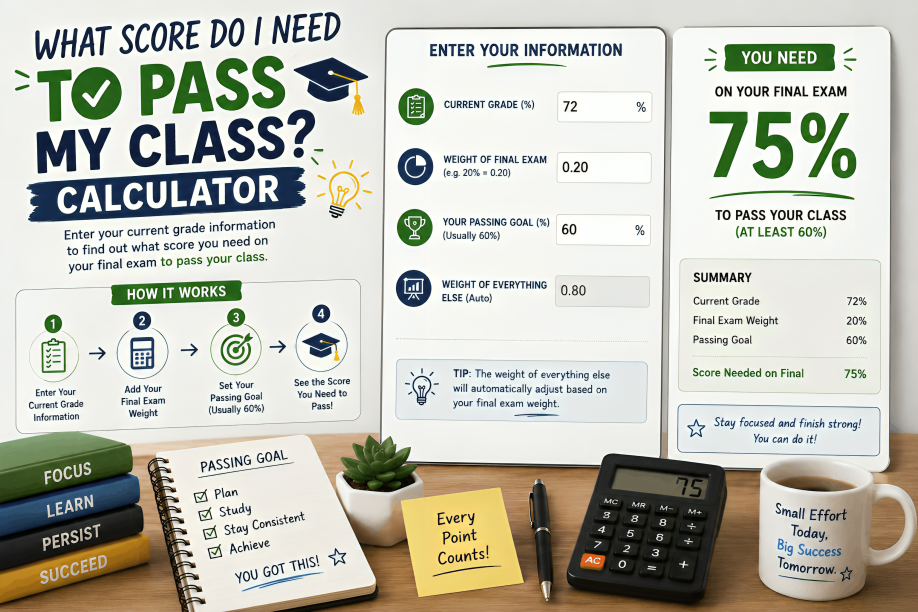
What Score Do I Need to Pass My Class Calculator?
Wondering what score you need to pass your class? A passing grade depends on your current grade, the percentage of the course already completed, the minimum passing percentage, and the weight of your remaining assignments or exams.
A What Score Do I Need to Pass My Class Calculator makes this calculation easier. Instead of manually working through percentages and weighted grades, you can enter your current grade, target passing grade, and remaining course weight to estimate the score you need.
Whether you are preparing for a final exam, trying to pass a difficult course, or checking how much your next assignment could affect your grade, this calculator can give you a quick estimate.
What Is a What Score Do I Need to Pass My Class Calculator?
A What Score Do I Need to Pass My Class Calculator is an online grade-planning tool that calculates the minimum score you need on an upcoming exam, assignment, project, or other assessment to reach a specific passing grade.
The calculator uses your current grade, the amount of coursework already completed, the weight of the remaining assessment, and your desired final grade.
For example, suppose your current grade is 68%, 80% of the course has been completed, and you need at least 60% overall to pass. If your final exam is worth the remaining 20%, the calculator can determine the score you need on that exam to finish the course with a passing grade.
This is useful because the required score is not always the same as the passing percentage. Your current performance and the weighting of future assessments can significantly change the result.
How Does the Passing Grade Calculator Work?
The calculator generally uses a weighted-grade equation.
The basic formula is:
Required Score = (Target Final Grade − Current Grade × Completed Weight) ÷ Remaining Weight
For example, assume:
- Current grade = 72%
- Completed coursework = 75%
- Final exam = 25%
- Passing grade = 60%
First, calculate the contribution from completed coursework:
72 × 0.75 = 54
You need a final grade of 60%, so:
60 − 54 = 6
Because the final exam represents 25% of the course:
6 ÷ 0.25 = 24%
You would therefore need approximately 24% on the final exam to finish with a 60% overall grade under these assumptions.
Your school’s grading system may use different rules, so always compare the calculator’s result with your official course syllabus or gradebook.

What Information Do I Need to Use the Calculator?
Most passing-grade calculators require only a few pieces of information.
Your Current Grade
Enter your current percentage or grade before the remaining assessment.
For example, if your gradebook shows 74%, enter 74.
Make sure you understand whether your displayed grade already includes all completed assignments and whether your learning platform calculates grades by points or weighted categories.
Your Target Passing Grade
Enter the minimum final grade required to pass.
For example, if your school considers 60% a passing grade, your target is 60%.
Passing requirements can differ between schools, courses, programs, and instructors. Some courses may require a higher minimum grade, particularly when a prerequisite or professional requirement is involved.
Completed Course Percentage
Enter the percentage of the course that has already been completed.
For example, if all completed work represents 80% of the final course grade, enter 80%.
Remaining Assessment Weight
Enter the percentage represented by the upcoming exam, assignment, or assessment.
If your final exam accounts for 20% of your final grade, enter 20%.
The completed and remaining weights should normally add up to 100%.
What Score Do I Need to Pass My Class?
The answer depends on your current grade and the weight of your remaining coursework.
Here is a simple example.
Suppose you currently have 65%, and 70% of the course has been completed. Your final exam is worth 30%, and you need 60% to pass.
The calculation is:
65 × 0.70 = 45.5
Then:
60 − 45.5 = 14.5
Finally:
14.5 ÷ 0.30 = 48.33
You would need approximately 48.3% on the final exam to finish with a 60% overall grade.
This example demonstrates why simply comparing your current grade with the passing grade may not tell you what you need on your final assessment.
How to Calculate the Score You Need Manually
You can calculate your required score without an online tool.
Use this formula:
Required Score = (Passing Grade − Current Grade × Completed Weight) ÷ Remaining Weight
Step 1: Identify Your Current Grade
Start with your current percentage.
For example:
Current grade = 70%
Step 2: Determine How Much of the Course Is Complete
Suppose 80% of the course has already been completed.
Convert the percentage into decimal form:
80% = 0.80
Step 3: Find the Current Contribution
Multiply your current grade by the completed weight:
70 × 0.80 = 56
Your completed coursework contributes 56 percentage points toward your final grade.
Step 4: Identify the Passing Grade
Suppose the passing grade is 60%.
You still need:
60 − 56 = 4
Step 5: Divide by the Remaining Weight
If the remaining exam is worth 20%:
4 ÷ 0.20 = 20%
You would need 20% on the remaining assessment to reach a 60% final grade.
Passing Grade Calculator Example
Consider a student with the following situation:
| Grade Information | Value |
|---|---|
| Current grade | 75% |
| Completed coursework | 80% |
| Final exam weight | 20% |
| Passing grade | 60% |
The student’s completed coursework contributes:
75 × 0.80 = 60
Because the student already has 60 percentage points toward the final grade, the required score on the remaining exam is:
(60 − 60) ÷ 0.20 = 0%
Under this simplified weighted-grade model, the student would mathematically need 0% on the final exam to finish with a 60% overall grade.
However, this does not necessarily mean the student can skip the exam. Some schools require students to complete every assessment regardless of their calculated overall grade.
What If I Want to Know the Score Needed for a Specific Final Grade?
You can use the same calculation to determine the score required for any target grade.
For example, suppose:
- Current grade = 78%
- Completed weight = 70%
- Remaining exam = 30%
- Desired final grade = 85%
The calculation is:
Required Score = (85 − 78 × 0.70) ÷ 0.30
First:
78 × 0.70 = 54.6
Then:
85 − 54.6 = 30.4
Finally:
30.4 ÷ 0.30 = 101.33%
The student would need approximately 101.3% on the remaining assessment.
That result tells you something important: an 85% final grade is mathematically unattainable with a single 30%-weighted assessment under these assumptions unless additional points, extra credit, or another grading adjustment is available.
Can I Still Pass If My Current Grade Is Below the Passing Grade?
Yes, depending on how much coursework remains.
A current grade below the passing threshold does not automatically mean you will fail. If a significant portion of the course remains, strong future scores may raise your final grade.
For example, a student with a 55% current grade may still have an opportunity to reach a 60% final grade if a large final assessment remains.
On the other hand, if only a small percentage of the course remains, there may be a mathematical limit to how high the final grade can rise.
The calculator helps identify that difference.
What If the Calculator Says I Need More Than 100%?
A required score above 100% means your target final grade cannot be reached through the remaining assessment alone under the entered assumptions.
For example, if the calculator gives:
Required score = 108%
you cannot normally achieve that result on a standard assessment capped at 100%.
This can happen when:
- Your current grade is too low.
- Your target grade is unusually high.
- The remaining assessment has a small weight.
- Most of the course has already been completed.
- Your grade information was entered incorrectly.
If extra credit is available, the situation may be different. Check your instructor’s grading rules before assuming extra credit will change the result.
What If the Calculator Says I Need 0%?
A result of 0% means your existing weighted coursework is already enough to meet the selected target grade under the calculation.
However, 0% does not necessarily mean you can ignore the remaining assessment.
Your course may have requirements such as:
- Mandatory final examinations
- Minimum exam scores
- Required projects
- Attendance requirements
- Assignment completion rules
- Department-specific grading policies
Always check the official requirements for your course.
How Does Extra Credit Affect the Calculation?
Extra credit can change the calculation because it may add points beyond the normal grading structure.
However, there is no universal extra-credit system. One instructor might add points directly to an assignment, while another might add percentage points to the final course grade.
For example, if an instructor allows additional points after the normal calculation, your required score could be lower than the standard calculator initially indicates.
Because extra-credit rules vary, enter the information according to the grading method used by your instructor.
What If My Class Uses Points Instead of Percentages?
Not every class uses weighted percentages.
Some instructors calculate grades using total points:
Points Earned ÷ Points Possible × 100 = Percentage Grade
For example, if you earned 420 points out of 500:
420 ÷ 500 × 100 = 84%
If your upcoming exam is worth 100 points, you can determine how many points you need by working with the course’s total points.
A percentage-based calculator may not accurately represent a points-based course unless the course weights are converted correctly.
Weighted Grades vs. Total Points
Understanding your school’s grading method is important before using a passing-grade calculator.
Weighted Grades
In a weighted system, categories or assessments contribute specific percentages to the final grade.
For example:
- Homework: 20%
- Quizzes: 15%
- Midterm: 25%
- Final exam: 40%
The final exam has a larger impact because it represents 40% of the course.
Total Points
In a points-based system, every assignment contributes according to its point value.
For example:
- Homework: 100 points
- Quizzes: 200 points
- Midterm: 300 points
- Final exam: 400 points
The final exam represents 400 of 1,000 total points.
Both methods can produce the same result in some circumstances, but they should not be mixed without checking the grading structure.
How Accurate Is a Passing Grade Calculator?
A calculator can be mathematically accurate when you enter accurate information and your course follows the assumptions used by the calculator.
However, the result can be misleading if your gradebook uses a different calculation method.
Before relying on the result, check:
- Your current grade.
- The amount of coursework completed.
- The exact weight of the remaining assessment.
- Your school’s passing requirement.
- Whether missing assignments are included.
- Whether extra credit affects the calculation.
- Whether your teacher uses weighted categories or total points.
The calculator should be treated as a planning tool rather than a replacement for your official gradebook.

Common Mistakes When Calculating a Passing Grade
Students often make small errors that can produce a very different result.
Using the Wrong Current Grade
Make sure you enter your current calculated grade rather than a single assignment score.
Forgetting the Assessment Weight
A final exam worth 40% has a much greater impact than an assignment worth 5%.
Confusing 20% With 0.20
When using decimal calculations, 20% must be represented as 0.20, not 20.
Using the Wrong Passing Requirement
Do not assume every class uses the same passing grade. Check your syllabus, school policy, or instructor’s grading information.
Ignoring Mandatory Assessments
A mathematical result does not override course requirements. You may still have to complete a final exam even if your current grade appears sufficient to pass.
Why Use a Calculator Instead of Doing the Math Yourself?
The formula is relatively simple, but an online calculator can reduce repetitive calculations and make it easier to test different scenarios.
For example, you can compare:
- What happens if I score 60%?
- What happens if I score 70%?
- What happens if I score 80%?
- What score guarantees my target grade under the model?
This can help you create a realistic study target instead of guessing how much you need.
How to Use a What Score Do I Need to Pass My Class Calculator
Using a passing-grade calculator generally takes only a few steps.
Step 1: Enter Your Current Grade
Type your current percentage into the calculator.
Step 2: Enter Your Target Grade
Enter the minimum final percentage you need to pass.
Step 3: Enter the Completed Course Weight
Add the percentage of the course that has already been graded.
Step 4: Enter the Remaining Assessment Weight
Enter the percentage represented by your upcoming exam, assignment, or project.
Step 5: Calculate
Select the calculate option to determine the approximate score required.
Step 6: Check the Result
Compare the calculated result with your official grading rules.
If the required score is above 100%, the selected target cannot normally be reached through that assessment alone.
Frequently Asked Questions
What score do I need to pass my class?
It depends on your current grade, the amount of coursework completed, the weight of your remaining assessments, and your school’s minimum passing grade. A calculator can combine these values to estimate the required score.
What is the formula for finding the score needed to pass?
The general formula is:
Required Score = (Target Grade − Current Grade × Completed Weight) ÷ Remaining Weight
Use decimal values for the weights, such as 0.80 for 80%.
Can I pass if my current grade is below 60%?
Possibly. If enough of the course remains, strong future scores may raise your final grade above the passing threshold. The exact result depends on the weighting of your remaining coursework.
What if I need more than 100% to pass?
A required score above 100% means the target cannot normally be achieved through the remaining assessment alone under the entered grading assumptions. Check whether additional assessments or officially permitted extra credit remain.
Does a final exam always determine whether I pass?
No. The final exam’s impact depends on its weight and your course rules. Some courses also have separate requirements that must be completed regardless of your calculated overall grade.
Can this calculator work with weighted grades?
Yes, provided you enter the correct current grade and remaining weight. Weighted categories should be handled according to your instructor’s grading system.
Can I use this calculator for college classes?
Yes. The same mathematical principles can apply to college courses, provided the course uses a compatible percentage or weighted-grade system.
What if my teacher uses total points?
If your class uses total points rather than weighted percentages, calculate using points earned and points possible or convert the grading structure appropriately. Do not assume a weighted-grade calculation matches a points-based gradebook.
Final Thoughts
A What Score Do I Need to Pass My Class Calculator can quickly show how much you need on an upcoming assessment to reach your desired final grade. The key inputs are your current grade, completed coursework, remaining assessment weight, and passing requirement.
Use the calculation to understand your position and set a realistic target for your next exam or assignment. Most importantly, verify the result against your official syllabus or gradebook because individual instructors and schools may use different grading policies.
Knowing exactly what score you need can turn an uncertain situation into a clear academic goal and help you focus your study time where it can have the greatest effect.