
Understanding the Concept of Grade Calculation
Grade calculation is the foundation of fair and accurate student assessment. By converting raw test scores into percentages and letter grades, educators can evaluate performance consistently across different assignments, quizzes, and exams.
An easy grader simplifies this process by comparing the total number of questions with incorrect answers and instantly generating a percentage score and corresponding letter grade. This automated approach eliminates manual calculations and ensures reliable results every time.
How Teachers and Students Use Easy Graders Daily
Teachers use easy graders to save time when grading multiple tests and assignments. Features such as one-click calculations, keyboard shortcuts, and real-time updates make the grading process faster and more efficient.
Students also benefit from easy graders by viewing grade charts and understanding how their scores translate into percentages and letter grades. Since these tools work on phones, tablets, and computers, they are accessible anytime and anywhere.
Breaking Free From the Grading Workload Trap
Manual grade calculations can consume valuable time and increase the risk of mistakes. For educators managing large classes, repetitive calculations often become one of the most time-consuming administrative tasks.
An easy grader streamlines the grading workflow by automating score conversions and calculations. This allows teachers to spend less time on paperwork and more time supporting student learning and classroom engagement.
Why Precision Matters in Every Single Score
Accuracy is essential in educational assessment because even a small calculation error can affect a student’s final grade. Consistent grading ensures fairness and helps maintain trust between students, teachers, and educational institutions.
A reliable grading calculator eliminates human error by automatically converting scores into percentages and letter grades. This ensures that every student is evaluated using the same standards and grading criteria.
One Tool Serving Every Layer of Education
Easy grading tools are valuable across all levels of education, from elementary classrooms to colleges and universities. They help maintain consistent grading policies while simplifying score calculations for teachers and administrators.
Students can track their academic progress, while institutions benefit from standardized grading practices. The flexibility of these tools makes them suitable for quizzes, assignments, tests, and comprehensive examinations.
The Arithmetic Behind Every Accurate Score
Most grading calculators use a straightforward formula: divide the number of correct answers by the total number of questions and multiply the result by 100. This calculation produces a percentage score that can be easily interpreted and compared.
Advanced easy graders go a step further by generating complete grading charts for all possible score combinations. This provides educators with a quick reference for converting scores into grades across various assessment formats.
Understanding What Each Grading Output Communicates
A percentage score provides a precise numerical measure of student performance, while a letter grade offers a simplified representation that is easier to understand. Together, they create a standardized system for communicating academic achievement.
Most grading scales assign letter grades based on specific percentage ranges. Although these thresholds may vary by institution, grading calculators allow educators to customize grade boundaries while maintaining consistency and fairness across all assessments.
Why Speed Without Sacrifice Defines a Great Grader
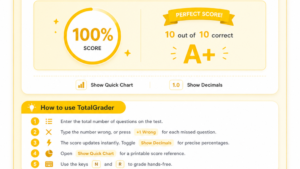
A high-quality easy grader combines speed, accuracy, and convenience to deliver instant percentage scores and letter grades without requiring manual calculations. Real-time updates allow teachers to enter scores and immediately view results, making the grading process faster and more efficient. At the same time, detailed grade charts and score breakdowns provide a complete overview of all possible outcomes for a specific test size, helping educators make informed grading decisions with confidence.
Equally important is the flexibility to adapt grading systems to different institutional requirements. Custom grade thresholds, adjustable grading scales, and personalized settings ensure that results align with school policies and academic standards. Whether used on a phone, tablet, or computer, a responsive grading calculator maintains consistent performance while reducing errors, saving valuable time, and allowing teachers to focus more on instruction rather than administrative tasks.
Measuring What Gets Recovered When Arithmetic Disappears
Manual grading often requires significant time and effort, especially when calculating percentages and letter grades for multiple assignments, quizzes, and exams. An easy grader eliminates repetitive arithmetic by automating calculations and instantly generating accurate results. This not only improves grading efficiency but also minimizes the risk of human error, ensuring that every student is assessed fairly and consistently.
The true value of an easy grader lies in the time it gives back to educators. Tasks that once took hours can be completed in minutes, allowing teachers to dedicate more attention to lesson planning, student support, and classroom engagement. By combining speed, reliability, and comprehensive grading tools, easy graders transform the assessment process into a streamlined workflow that benefits both teachers and students.
Built From Teaching Realities, Not Theoretical Assumptions
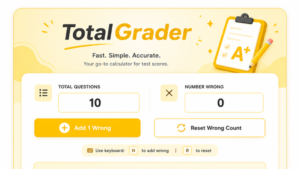
Easy graders are designed to solve real classroom challenges by replacing time-consuming manual calculations with fast and accurate results.
Teachers can quickly grade quizzes, tests, and exams while maintaining consistency and reducing workload.
Taking Ownership of Scores Before Results Are Announced
Students can use grade calculators to understand how their scores translate into percentages and letter grades before receiving official results.
This encourages academic awareness and helps learners identify areas for improvement.
Scaling Grading Consistency Across Entire Institutions
Schools and colleges use shared grading systems to ensure fair and consistent assessment standards across departments.
Custom grade thresholds and flexible settings allow institutions to align grading with their specific academic policies.
The Silent Errors That Corrupt Every Grade Downstream
Most grading mistakes occur because of incorrect data entry rather than flaws in the grading tool itself.
Verifying total questions and incorrect answers helps ensure accurate and trustworthy results.
When the Right Score Gets Assigned the Wrong Meaning
Different schools may use different grading scales, causing the same percentage to receive different letter grades.
Understanding institutional grading policies is essential for accurate interpretation of results.
Precision That Practitioners Actually Depend Upon
Reliable grading calculators eliminate manual errors and provide consistent results across every assessment.
Automatic percentage and letter grade conversion ensures fairness and accuracy for all students.
Where Easy Graders Prove Their Worth Beyond the Classroom
Easy graders support a variety of educational settings, including schools, colleges, online courses, and exam preparation programs.
They simplify grading for quizzes, assignments, tests, and large-scale assessments alike.
The Verification Habit That Separates Good Graders From Great Ones
Successful grading begins with confirming that all input data is correct before calculations are performed.
A simple verification step helps prevent errors and improves confidence in final results.
Scale Selection as a Professional Responsibility
Choosing the correct grading scale ensures that percentages are converted into accurate letter grades.
Teachers should always confirm grading policies and customize calculator settings to match institutional requirements.
Faqs:-
1. How do you calculate percentages for grades?
To calculate percentages for grades, divide the number of correct answers by the total number of questions and multiply by 100. For example, if you score 45 out of 50, your percentage is (45 ÷ 50) × 100 = 90%. This method is widely used in most grading systems for accuracy and consistency.
2. What is a grade chart and how is it used?
A grade chart is a reference table that converts percentages into letter grades (such as A, B, C). Teachers and students use a grade chart to quickly determine performance levels. For example, 90–100% is typically an A, while 80–89% is a B, depending on the grading scale.
3. How does an assignment grade calculator work?
An assignment grade calculator helps you determine your score by entering total points and points earned. It automatically calculates your percentage and sometimes converts it into a letter grade, saving time and reducing manual errors.
4. How do you convert letter grading to percentage?
To convert letter grading to percentage, use a standard grading scale. For example, an A is usually 90–100%, a B is 80–89%, and a C is 70–79%. However, exact values may vary depending on your school or institution’s grading policy.
5. What is an online grading calculator and is it accurate?
An online grading calculator is a digital tool that instantly calculates grades based on inputs like total marks and correct answers. Most reliable tools are highly accurate as they use standard mathematical formulas, making them trustworthy for both students and teachers.
Conclusion
Easy graders have transformed the way educators calculate and interpret student performance. By combining speed, accuracy, and consistency, these tools reduce administrative workload while ensuring fair and reliable grading practices. Whether used for daily quizzes, major exams, or classroom assignments, an easy grader provides a practical solution that helps teachers focus more on teaching and less on calculations.
Disclaimer

The results and grades provided by TatolGrader.com are for informational and reference purposes only and should not be considered as official academic evaluations. We do not guarantee the accuracy, completeness, or reliability of any grading results generated on this platform. TatolGrader.com is not affiliated with any educational institution and holds no responsibility for decisions made based on the information provided. By using this site, you agree that the platform bears no liability for any errors, omissions, or outcomes resulting from your use of this service.